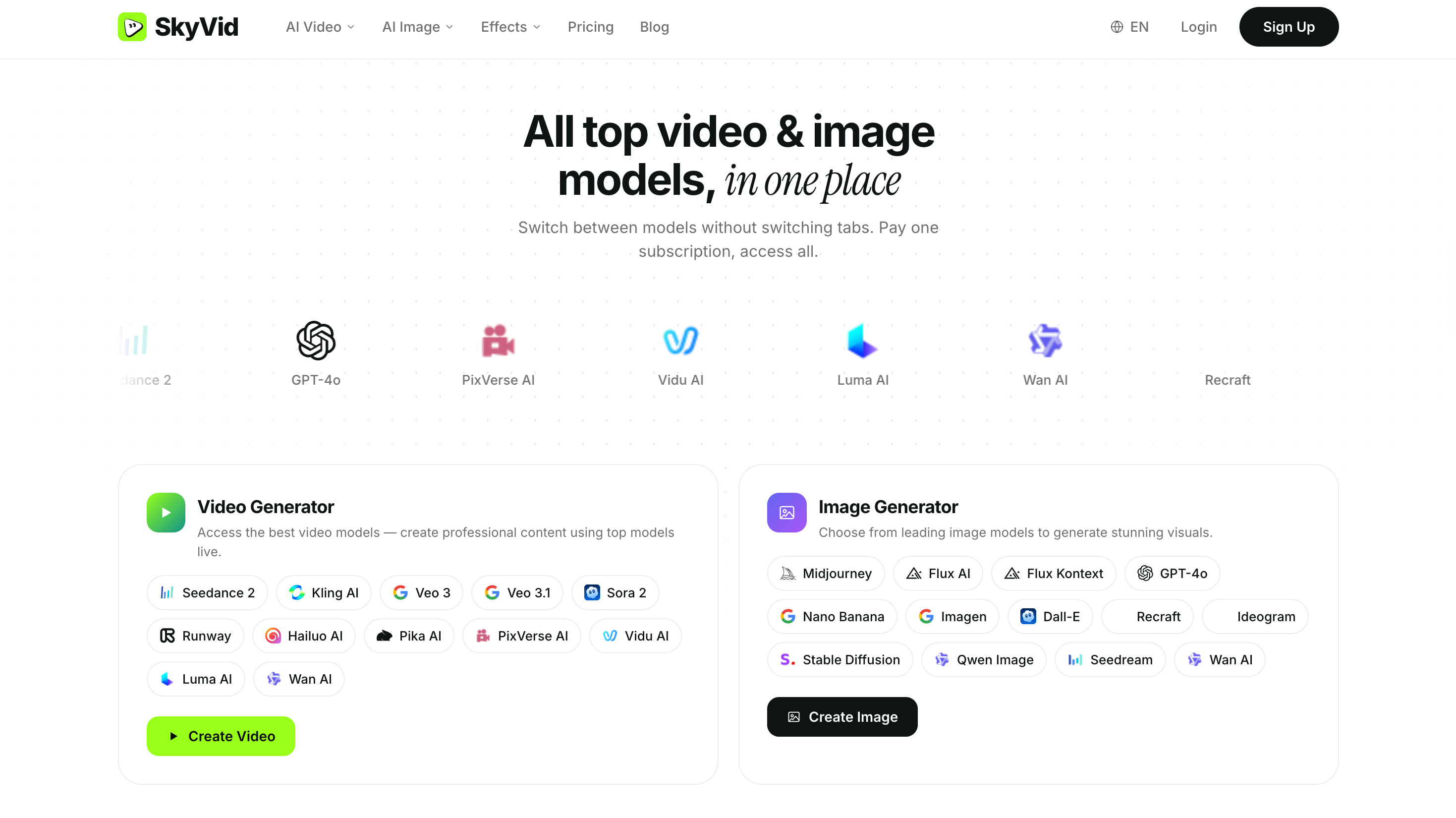


SkyVid is an AI-powered creative platform that consolidates multiple leading video and image generation models into a single workspace. Rather than subscribing to separate services for different AI models, users can access tools like Veo 3.1, Sora 2, Kling 2.5, Hailuo, Seedance, Runway Gen4, and various image generators including Midjourney, Flux, and GPT-4o Image from one interface with a unified credit system.
The platform appears designed for content creators, marketers, educators, and developers who need flexible access to frontier AI models without managing multiple subscriptions. With claims of 10 million users worldwide, SkyVid positions itself as an all-in-one studio for generating professional videos and images for social media, presentations, and commercial projects.
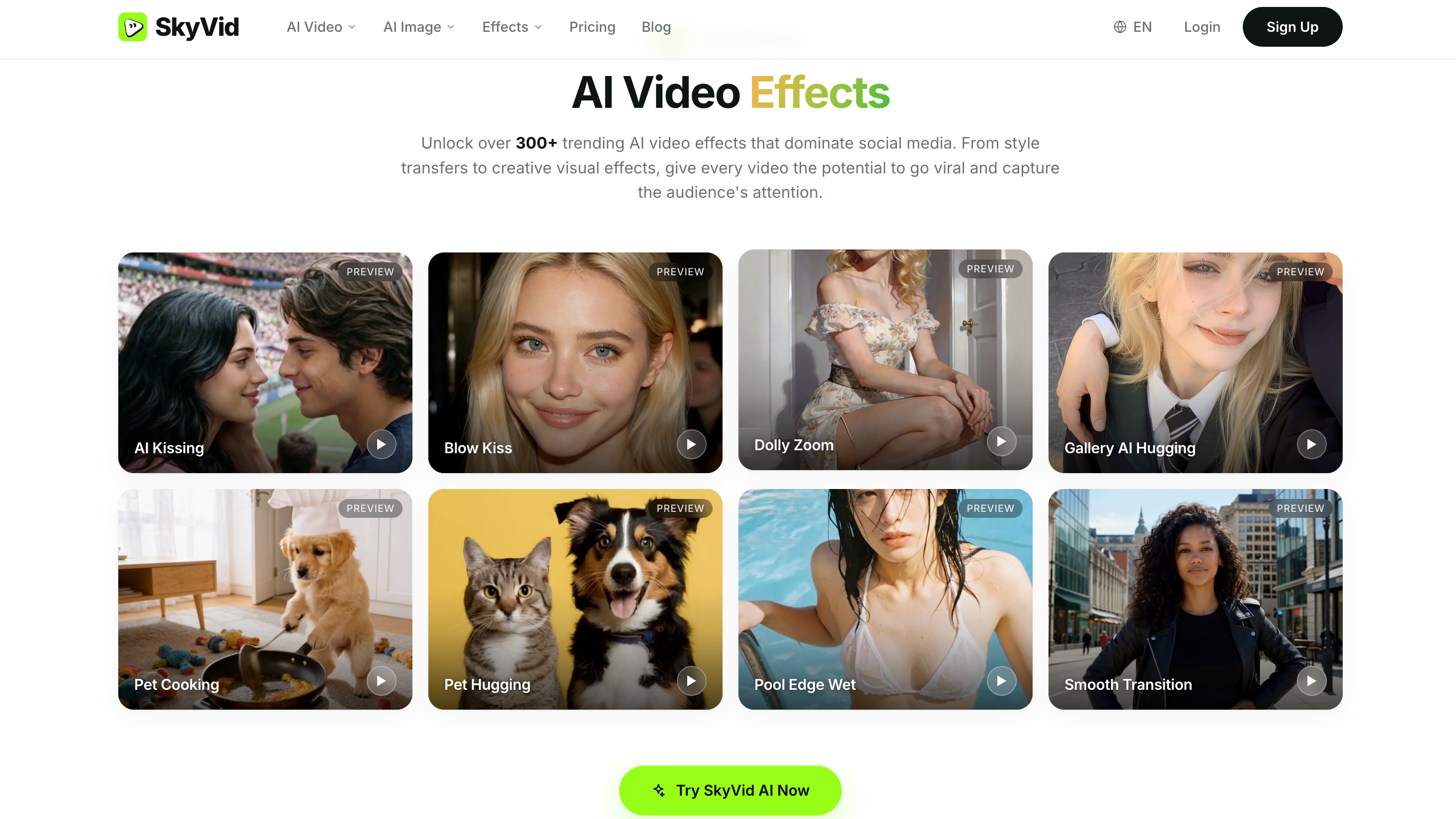
SkyVid appears tailored for creators producing social media content at scale, particularly those creating short-form video for platforms like TikTok and Reels. The viral effects templates and one-click animations suggest a workflow optimized for trending content formats where speed and volume matter more than fine-grained control.
Marketing teams and entrepreneurs may find value in the pitch deck and product launch workflows, using text-to-video to generate promotional content without traditional video production overhead. The talking avatar and lip-sync features suggest applications for explainers, demos, and localized content where recording talent may be impractical.
Educators and course creators can leverage the avatar generation and presentation tools to produce instructional videos without appearing on camera. The platform's model variety allows experimentation to find the right aesthetic for different subject matter, from photoreal product visuals to stylized character animations.
Developers and designers may use the image generation and reference-based video tools for rapid prototyping of visual concepts, though the platform seems primarily optimized for content creation rather than technical integration workflows.
SkyVid operates on a credit-based subscription model with three tiers:
Lite: $9.90/month (billed annually at $118.80, save 34%) includes 1,000 credits monthly, access to advanced models including Seedance 2.0, Nano Banana Pro, Kling 3.0 Pro, and Seedream 5.0, plus all video and image models, no watermarks, commercial license, and AI prompt assist.
Pro: $17.90/month (billed annually at $214.80, save 40%) includes 2,500 credits monthly with everything in Lite plus faster generation speeds, priority support, and early access to new models.
Max: $59.90/month (billed annually at $718.80, save 33%) includes 8,000 credits monthly with everything in Pro plus priority render queue, highest concurrency, and dedicated support.
Credit costs vary by model and resolution. For example, Seedance 2.0 at 720p runs 41 credits per second, Veo 3.1 Fast 1080p costs 38 credits per clip, and images start at 1 credit. Subscription credits refresh monthly; additional credit packs can be purchased and never expire. Annual plans save up to 40% compared to monthly billing. New users receive 10 free generations on signup with no credit card required.
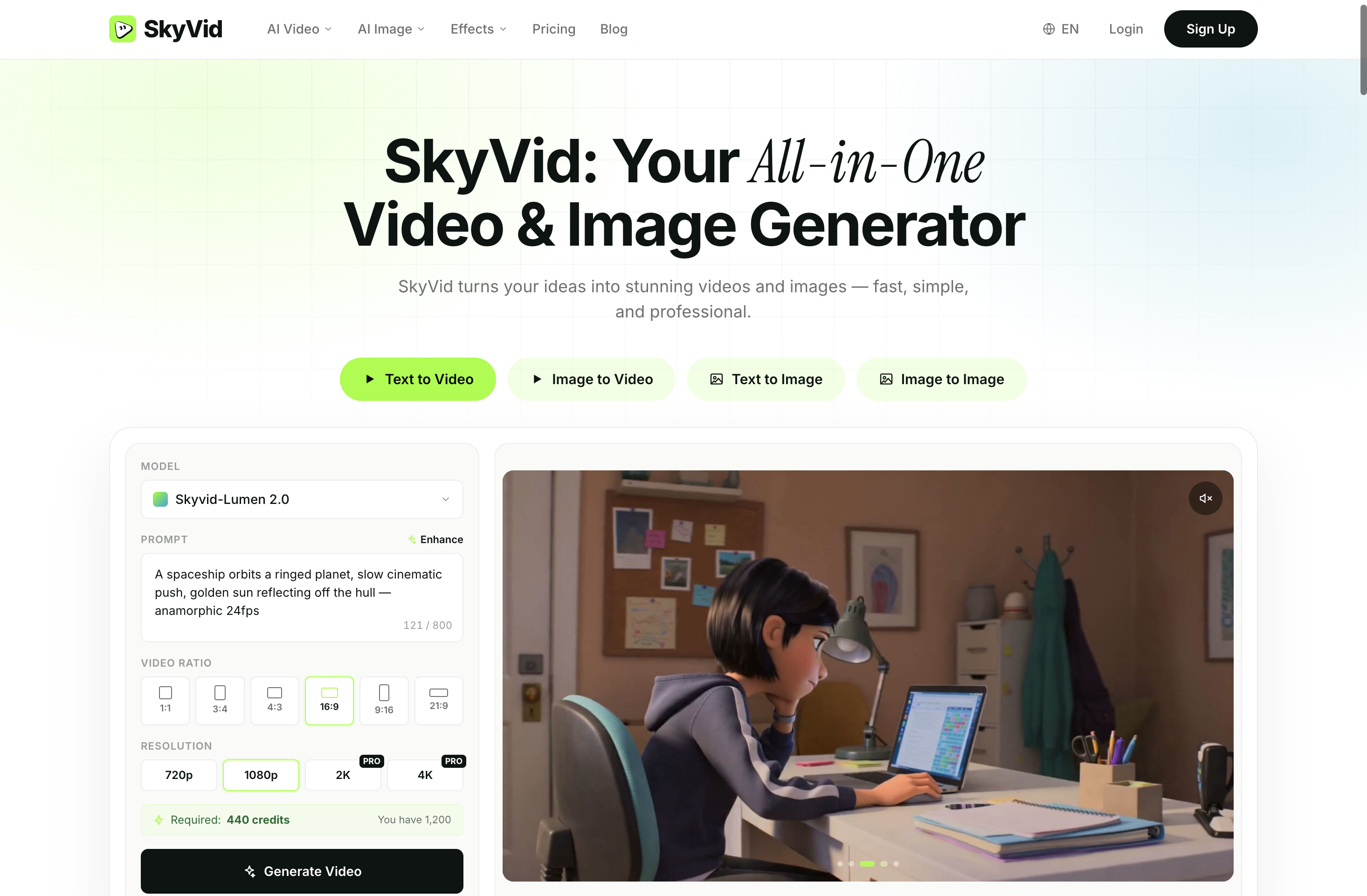
The interface emphasizes quick access to generation tools with model selection, prompt input, aspect ratio controls, and resolution settings visible on the main workspace. Users can switch between models without navigating separate tabs or managing multiple subscriptions.
SkyVid offers priority support for Pro and Max subscribers, with dedicated support included at the Max tier. The platform maintains a Discord community and YouTube presence for user engagement and tutorials. The Chrome extension badge suggests browser integration, though specific functionality details are not visible in the extracted evidence.
Cancellation is available from the billing section with one-click functionality, and users retain access until the end of their billing period. The platform does not appear to offer prorated refunds.
SkyVid functions as a web-based platform accessible through standard browsers without requiring downloads or installations. The service aggregates multiple third-party AI models through API integrations rather than hosting proprietary models.
Key technical specifications from the model catalog include:
The platform supports outputs up to 4K resolution with sub-minute generation times for most content. The credit system scales costs with resolution and duration rather than prompt complexity.
Pros
Cons
SkyVid is a unified AI creative platform that provides access to leading video and image generation models through a single subscription. Users can generate professional videos and images using models like Veo 3.1, Sora 2, Kling 2.5, Seedance, Runway, Midjourney, Flux, and more without subscribing to each service individually.
The platform appears best suited for content creators, marketers, educators, and entrepreneurs who need regular access to multiple AI models for social media content, presentations, explainer videos, and commercial projects. The viral effects templates suggest particular appeal for creators focused on trending short-form video formats.
Users can verify the three subscription tiers (Lite, Pro, Max), credit costs per model and resolution, the complete list of supported video and image models, available aspect ratios and resolutions, commercial licensing terms, and the free trial offering 10 generations without credit card requirements.
Users should verify whether their specific use cases align with the credit consumption rates, as 4K outputs and longer videos may deplete monthly allowances quickly. Those needing API access, bulk processing, or deep integration with existing workflows should confirm these capabilities are available. Users should also test output quality across different models during the free trial to ensure results meet their standards.
The public page states that users can cancel anytime and keep access until the end of the billing period, but does not mention refunds or prorated credits. Users should verify the refund policy before subscribing if flexibility is important.
SkyVid's value proposition centers on cost savings and convenience-paying one subscription instead of multiple, switching models without account management, and accessing viral effect templates. However, heavy users of a single model may find direct subscriptions more economical depending on usage patterns.
SkyVid offers a practical solution for creators who need flexible access to multiple AI video and image models without the overhead of managing separate subscriptions. The credit-based system and wide model selection make it particularly suitable for users who value experimentation and variety over deep specialization in any single tool.
The platform's strength lies in its convenience-one workspace, one bill, and quick switching between models for different project needs. However, users should carefully evaluate credit consumption for their typical workloads, as costs can escalate with higher resolutions and longer outputs. The free trial provides a reasonable opportunity to test quality and workflow fit before committing to a paid plan.
Arya
The One Startup : Navigate. Build. Grow.

Build Trust with DR Checker
Discover the Best AI Tools & SaaS Solutions
Get your brand featured here
Discover similar products in the same category

Seed Audio 1.0 is ByteDance Seed's all-in-one audio generation model for creating complete sound sce

## Introduction Honeyb is AI visibility software built for Answer Engine Optimization - the practice of monitoring and improving how brands appear in AI-generated answers. The platform tracks brand mentions, recommendation share, sentiment, and citation sources across eight AI engines (ChatGPT, Gemini, Claude, Perplexity, Google AI Mode, Google AI Overviews, Microsoft Copilot, and Grok) and delivers daily visibility scores with weekly recommendations. The core insight on the site is direct: when a buyer asks an AI for the best tool or vendor, the answer is a shortlist of three to five names, and there is no second page to climb. Honeyb gives marketing teams a way to see which shortlist they are on - and which ones they are not. ## Key Features - **AI Visibility Score** - a daily percentage showing how often the brand appears in AI answers, tracked against competitors over 7-day, 30-day, and 90-day windows - **Topic Performance** - visibility broken down by topic category (e.g., project management, team collaboration), showing where the brand appears and where it does not - **Citation Source Tracking** - domain-level breakdown of which sources (G2, Forbes, Reddit, Product Hunt, etc.) the AI models cite when mentioning the brand - **Sentiment and Risk Monitoring** - tracks whether AI mentions are positive, neutral, or negative, and flags emerging risks - **Competitor Benchmarking** - compare visibility and recommendation share against named competitors in each workspace - **Honeyb Recommendations** - weekly actionable suggestions on content, sources, and PR moves, ranked by estimated impact - **Workspace Organization** - group tracking by brand, product line, audience, market, or language, with separate competitors and citations per workspace - **Free AI Visibility Check** - enter a domain and get an instant visibility report across AI platforms without signing up ## Use Cases SEO and content teams can use Honeyb to understand which topics and source citations drive AI recommendations in their category, then adjust their content and PR strategy to improve visibility. The citation source breakdown shows whether review sites, editorial coverage, or forum mentions are doing the most work - which directly informs where to invest outreach effort. PR and brand teams tracking reputation across AI engines can monitor sentiment and risk signals daily, catching negative mentions or competitive displacement early. Because AI answers are concise and influential - the site notes that AI typically returns three to five names - a brand that disappears from the shortlist effectively ceases to exist for that buyer query. Global brands operating across multiple markets and languages can use workspaces to track visibility per region or product line, with separate competitor sets and citation tracking for each. The Full Spectrum and Enterprise tiers support multi-brand, multi-market, and multi-language monitoring in a single account. ## Pricing Honeyb offers four tiers with monthly or annual billing (20% discount on annual): - **The Minimum** - $29/month: 10 prompts daily, 1 AI engine of choice, 1 workspace, 1 seat, competitor tracking, citation tracking, Honeyb Recommendations, weekly email report, email support (no free trial) - **Multi-Model** - $79/month: 50 prompts daily, 3 engines of choice, up to 5 workspaces, unlimited seats, multi-brand/multi-market/multi-language tracking, 14-day free trial - **Full Spectrum** - $149/month: 100 prompts daily, all 8 engines (including Google AI Mode and AI Overviews), up to 10 workspaces, unlimited seats, monthly 30-minute visibility review with the Honeyb team, priority support, 14-day free trial - **Enterprise** - custom pricing: custom prompt volume (fair-use), all 8 engines plus new models on launch, unlimited workspaces and seats, custom prompt strategies built with the Honeyb team, white-label reporting, API access, SSO/SAML, audit logs, quarterly business review, dedicated account manager, dedicated Slack channel, priority onboarding The [pricing page](https://www.honeyb.ai/pricing) has full details and a plan-comparison table. ## User Experience and Support The dashboard centers on an AI Health Report with four panels: visibility score and trend, topic performance, top citation sources, and sentiment and risks. Users set up tracking in five steps: add prompts (the questions buyers ask), add competitors, choose AI models to track, view the daily visibility score, and act on weekly recommendations. Support varies by tier: email support on The Minimum and Multi-Model, priority support with monthly 30-minute reviews on Full Spectrum, and a dedicated Slack channel with account manager on Enterprise. All paid tiers above The Minimum include a 14-day free trial. The company is registered in Latvia (SIA Honeyb, Reg. Nr. 40203724531). ## Technical Details Honeyb runs as a web platform. It tracks eight AI engines: ChatGPT, Google AI Mode, Google AI Overviews, Microsoft Copilot, Perplexity, Gemini, Grok, and Claude. Workspaces organize tracking by brand, product line, audience, market, or language, with a minimum of 10 prompts per workspace. The Enterprise tier adds API access, SSO/SAML authentication, audit logs, and white-label reporting. The site mentions Slack integration for the Enterprise tier's dedicated channel. No browser extension or CMS plugin is listed. ## Pros and Cons **Pros** - Addresses a real gap: most marketing teams cannot see what AI models tell buyers about their brand - Tracks eight AI engines including Google AI Mode and AI Overviews, which are emerging search surfaces - Citation source breakdown shows exactly which external content drives AI recommendations - Workspace model supports multi-brand, multi-market, and multi-language tracking - Free visibility check requires no sign-up, lowering the barrier to first insight - Weekly recommendations turn monitoring data into actionable next steps **Cons** - The Minimum tier has no free trial, which may discourage testing at the entry level - Prompt-based tracking means users must define the questions to monitor; coverage depends on prompt quality - Pricing starts at $29/month for a single engine, which may feel steep for small brands testing one model - Enterprise pricing is not publicly listed ## FAQ ### What is Honeyb and what problem does it solve? Honeyb is AI visibility software for Answer Engine Optimization. It tracks how brands appear in AI-generated answers across ChatGPT, Gemini, Claude, Perplexity, and other AI engines. The problem it addresses: when buyers ask AI for recommendations, the answer is a shortlist of three to five names, and brands that do not appear effectively do not exist for that query. ### How does Honeyb differ from traditional SEO tools? Traditional SEO tools track rankings in search engine result pages with ten blue links. Honeyb tracks visibility in AI-generated answers, which return a small set of names rather than a ranked list. The site FAQ addresses this comparison directly. ### What is a workspace in Honeyb? A workspace is a grouping for tracking - one per brand, product line, audience, market, or language. Each workspace has its own competitors, citations, and recommendations. The minimum is 10 prompts per workspace. ### Does Honeyb offer a free trial? The Minimum tier does not include a free trial. Multi-Model, Full Spectrum, and Enterprise all include a 14-day free trial. There is also a free AI visibility check that does not require sign-up. ### What AI engines does Honeyb track? Honeyb tracks eight engines: ChatGPT, Google AI Mode, Google AI Overviews, Microsoft Copilot, Perplexity, Gemini, Grok, and Claude. The Minimum tier covers one engine, Multi-Model covers three, and Full Spectrum and Enterprise cover all eight. ### Can I switch tiers later? Yes. The site FAQ confirms that users can switch between tiers as their monitoring needs change. ## Conclusion Honeyb targets a problem that most marketing teams have not yet instrumented: understanding what AI models tell buyers about their brand. The daily visibility score, citation source breakdown, and weekly recommendations turn an invisible channel into a measurable one. The free visibility check is a practical entry point, and the workspace model scales from a single-engine monitor to multi-brand, multi-market tracking. For teams that want to see - and improve - their position in AI-generated answers, the [Honeyb site](https://www.honeyb.ai/) is the place to start.