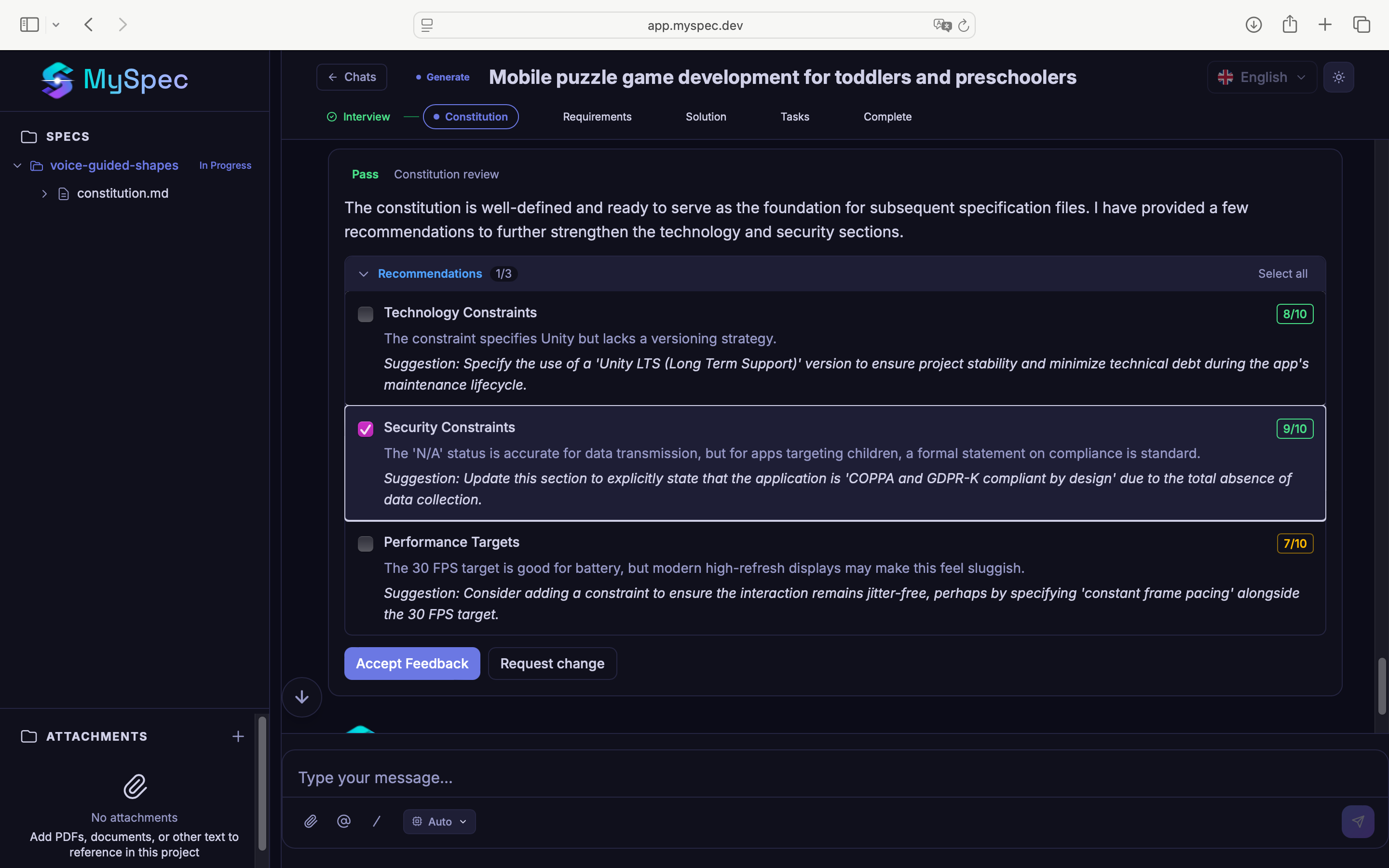
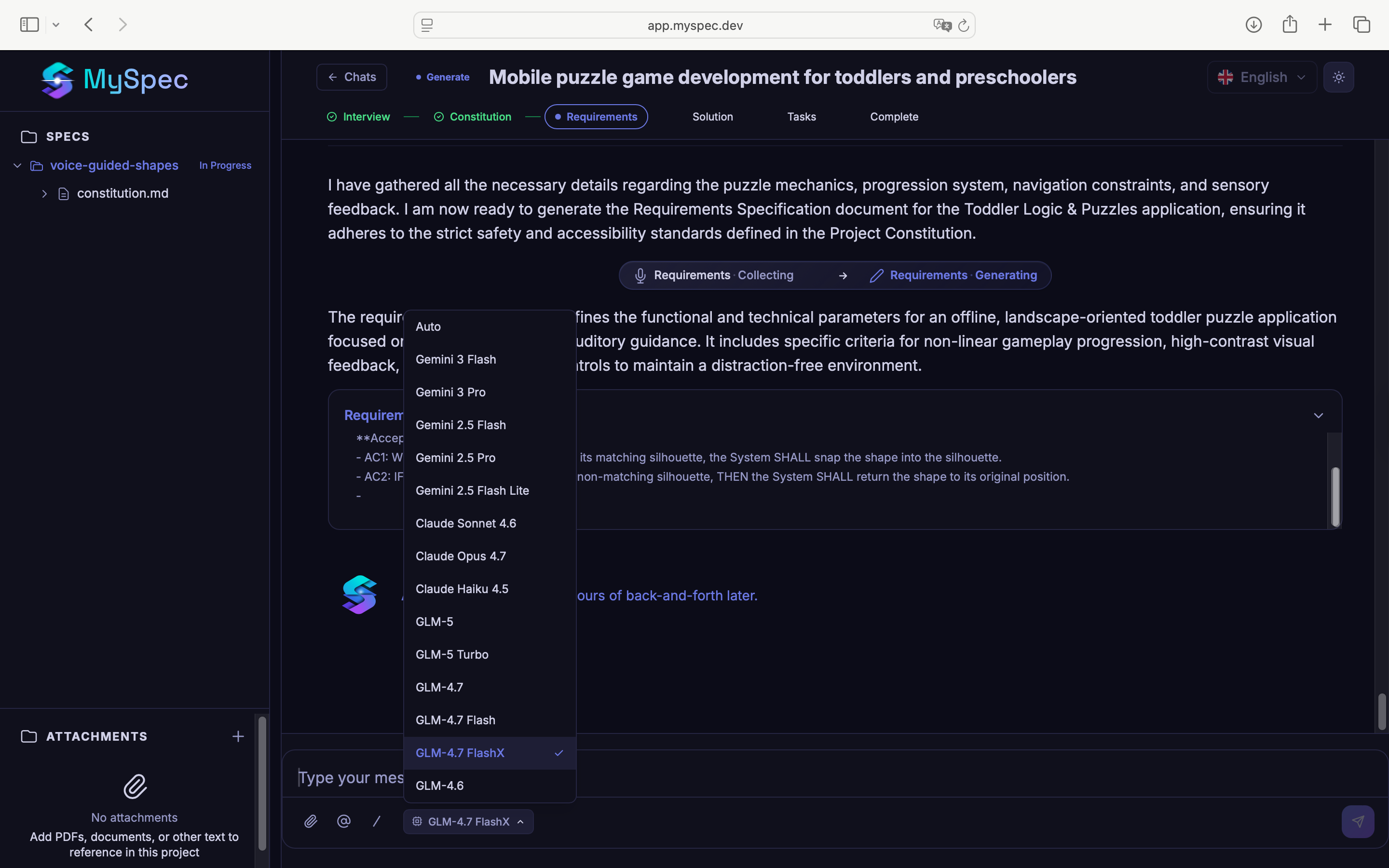
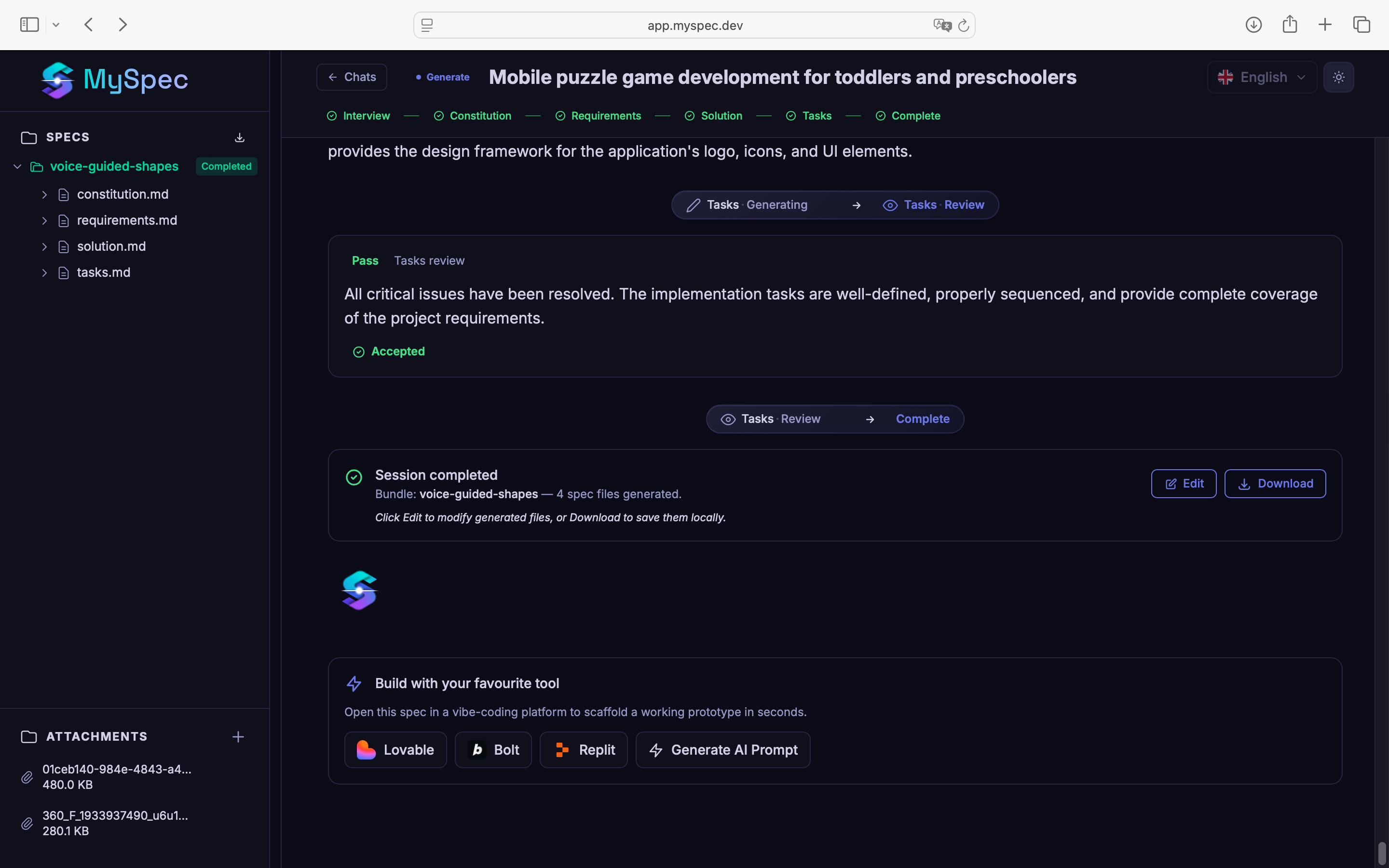
MySpec is an AI-powered platform for Spec-Driven Development that transforms vague software ideas into structured technical specifications. Rather than immediately jumping into code generation, MySpec interviews users like a senior architect to produce a four-file spec bundle-constitution.md, requirements.md, solution.md, and tasks.md-designed to provide the context AI coding agents actually need for implementation.
The platform addresses a common pain point in AI-assisted development: the gap between a rough concept and the detailed, coherent specifications that coding assistants like Cursor, Claude Code, and Codex require to produce useful output. By structuring the specification process before code generation begins, MySpec aims to reduce the iterative back-and-forth that often consumes development time.
Currently in open beta, MySpec offers unlimited AI usage during the testing period with pricing expected to kick in at general availability.
Four Specialized AI Agents
MySpec deploys Analyst, Architect, Designer, and Reviewer agents that collaborate behind a single conversational interface. The Analyst extracts the shape of the problem from rough inputs like paragraphs, Slack threads, or voice notes. The Architect and Designer develop technical approaches. The Reviewer validates completeness and consistency.
Structured Spec Bundle
Every project generates four markdown files that serve as canonical documentation:
Vibe Specify'ing
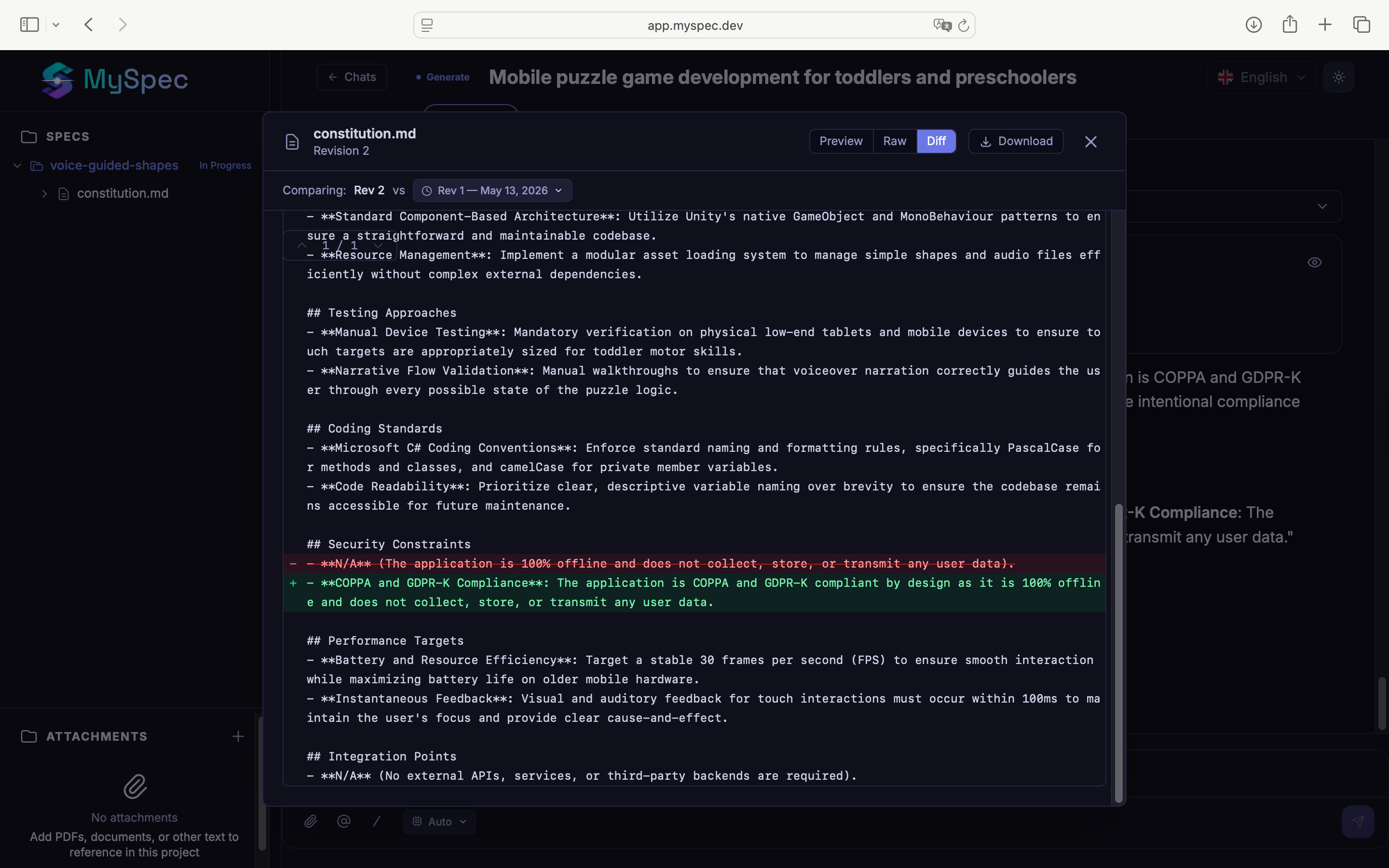
Users can edit the spec bundle in plain English through conversational interface. Requests like "Make the API more secure" are interpreted by the agents and applied as structured changes with diffs showing exactly what was modified across the four files.
EARS+ Acceptance Criteria
Every requirement ships with testable acceptance criteria using WHEN/IF/THE-system-SHALL clauses. This format ensures requirements are unambiguous and verifiable, reducing interpretation errors during implementation.
Live Mermaid Preview
As solution.md is written, flowcharts, ER diagrams, and sequence diagrams render live. This visual feedback helps users understand system architecture before committing to implementation.
Multi-Platform Export
The spec bundle exports as ZIP, clipboard copy, or direct integration with .specs/ directories for Cursor, Claude Code, and Codex. Future CLI tools (Q2 2026) will enable bi-directional sync between cloud and local environments.
AI-Assisted Development Workflows
Developers using Cursor, Claude Code, or Codex can feed MySpec-generated specifications directly to their coding agents. The structured context reduces hallucinations and off-target implementations that occur when AI assistants lack clear requirements.
Technical Design Before Coding
Teams practicing Spec-Driven Development can use MySpec to document architecture decisions, API contracts, and system boundaries before writing implementation code. This supports code reviews, onboarding, and maintenance.
Rapid Prototyping
Product managers and founders can transform rough concepts into implementation-ready specifications without writing detailed documentation manually. The structured interview process extracts scope, user flows, and edge cases through 5-15 targeted questions.
Cross-Functional Alignment
The four-file bundle serves as a shared reference between product, design, and engineering teams. Constitution.md captures business constraints; requirements.md defines functionality; solution.md documents technical approach; tasks.md breaks work into assignable units.
Legacy System Documentation
Teams maintaining existing codebases can use MySpec to reverse-engineer specifications from current implementations, creating documentation that may be missing or outdated.
Onboarding and Knowledge Transfer
Structured spec bundles help new team members understand system architecture, design decisions, and implementation patterns without relying on tribal knowledge.
MySpec operates on a freemium model with three tiers:
Free Plan
Pro Plan ($ pricing not disclosed)
Team Plan ($ pricing not disclosed)
Current Promotion
During open beta, all tiers offer unlimited AI access. Users can try Pro and Team features without limits. Pricing activates at general availability, with current users grandfathered into appropriate tiers.
All plans support unlimited projects and specs-the only scaling factor is AI usage volume.
Interview-Based Workflow
Rather than blank-page documentation, MySpec guides users through structured conversations. The Analyst agent asks clarifying questions about scope, users, flows, and edge cases, extracting necessary context without requiring users to know what information is relevant upfront.
Version-Controlled Truth
The spec bundle serves as living documentation that evolves with the project. Changes are tracked with diffs, maintaining history of how requirements and solutions developed over time.
No-Code Specification
Users describe desired outcomes in plain English. The AI agents translate these descriptions into structured technical specifications, lowering the barrier for product managers and non-technical stakeholders to contribute to system design.
Support Channels
Educational Resources
The EARS+ reference documentation explains requirement syntax. Blog content covers tutorials, releases, and behind-the-scenes development insights.
Four-Phase Workflow
EARS+ Syntax
The Easy Approach to Requirements Syntax ensures requirements are:
Mermaid.js Integration
Diagrams render from inline markdown using Mermaid.js syntax, including:
Integration Roadmap
Supported Coding Agents
Spec bundles are designed for direct consumption by:
Pros
Cons
What is Spec-Driven Development?
Spec-Driven Development is an approach that treats structured specifications as the primary artifact of the development process. Rather than jumping directly from rough ideas to code, teams document architecture, requirements, and implementation plans in machine-readable formats that both humans and AI agents can consume. This reduces misinterpretation and provides clear acceptance criteria for generated code.
How is MySpec different from asking Claude or ChatGPT to write code?
General-purpose AI assistants generate code based on conversational context that may be incomplete or misunderstood. MySpec produces a structured four-file specification that captures constraints, requirements, technical design, and implementation tasks in a format optimized for coding agents. This structured context reduces hallucinations and produces more aligned implementations.
What is the purpose of each file in the spec bundle?
What is EARS+ and why does it matter?
EARS+ (Easy Approach to Requirements Syntax) is a structured format for writing requirements that are unambiguous and testable. Each requirement uses WHEN/IF/THE-system-SHALL clauses that define exact conditions and expected behavior. This matters because vague requirements lead to implementation mismatches and rejected code. EARS+ requirements can be directly translated into test cases.
Can I modify the spec bundle after it's generated?
Yes. The Vibe Specify'ing feature allows editing in plain English. Describe the change you want-"Add user authentication to the API" or "Make the database schema support multi-tenancy"-and the agents apply modifications across relevant files with diffs showing exactly what changed.
How does the interview process work?
Paste a rough description of your idea-paragraph, Slack thread, voice note. The Analyst agent extracts the core problem shape, then conducts a structured back-and-forth asking 5-15 questions to clarify scope, users, flows, and edge cases. This interview replaces the blank-page problem with guided discovery.
What coding agents can consume MySpec output?
Current export supports Cursor (via .specs/ directory), Claude Code, and Codex. Future integrations include direct GitHub support and VS Code extensions. The markdown format is human-readable and can be adapted for other tools.
When will the CLI be available?
Bi-directional CLI sync (myspec pull/push) is scheduled for Q2 2026. This will include local file watching and conflict resolution between cloud and local spec versions.
Is my data private?
Specific privacy policies are not detailed in available materials. Users should review the published privacy policy and terms of service for data handling practices, retention policies, and whether specs are used to train models.
What happens to my specs if I downgrade or cancel?
Export functionality allows downloading spec bundles as ZIP files. Users should maintain local backups of critical specifications, particularly before making subscription changes.
MySpec addresses a real gap in AI-assisted development: the chasm between rough ideas and the detailed, structured context that coding agents need to produce useful output. By structuring the specification process through a guided interview and producing a four-file canonical bundle, it reduces the trial-and-error cycle that often dominates AI coding workflows.
The platform's strength lies in its disciplined separation of concerns-constitution, requirements, solution, and tasks mirror how experienced architects decompose problems. The EARS+ syntax ensures requirements are testable rather than vague, and live Mermaid previews make architecture discussable before implementation commits are made.
However, MySpec is not a magic bullet. Its effectiveness depends entirely on the quality of information provided during the interview phase. Teams that struggle to articulate requirements will likely produce weak specifications regardless of the AI assistance. Additionally, for simple projects or rapid prototypes, the overhead of full specification may exceed the value.
The open beta offering unlimited AI access provides a genuine opportunity to evaluate whether MySpec's structured approach fits your team's workflow. Developers already using Cursor, Claude Code, or Codex will find the export integration immediately useful. Teams practicing or moving toward Spec-Driven Development will appreciate the version-controlled, living documentation model.
Before committing to paid tiers at general availability, teams should test MySpec with real project specifications to verify:
For teams struggling with AI coding assistants producing off-target implementations, MySpec offers a structured path to better alignment. For teams already producing clear specifications manually, the value proposition depends on time savings from AI-assisted spec generation.
The platform shows promise as infrastructure for the emerging pattern of AI-human collaborative development. Whether it becomes essential tooling depends on execution of the roadmap-particularly CLI sync and IDE integrations-and how pricing aligns with usage patterns at general availability.
Build Trust with DR Checker

Discover the Best AI Tools & SaaS Solutions

The One Startup : Navigate. Build. Grow.
Get your brand featured here
Discover similar products in the same category
## Introduction [TechFusionGear](https://techfusiongear.com/our-services) presents itself as an Ahmedabad-based technology partner offering web and mobile development, design, SEO, paid advertising, and ongoing maintenance. The public site describes end-to-end digital work-from WordPress, Laravel, and Shopify builds to Google Ads, local SEO, and hosting support-for businesses that want a single vendor rather than juggling separate freelancers. Prospective clients should still request a scoped proposal and verify which service lines match their industry, since the catalog is broad. ## Key Features - **Development stack:** Listed specialties include WordPress, Shopify, WooCommerce, Laravel, and CodeIgniter for web applications and stores. - **Marketing services:** Instagram, Facebook, Google Ads, and PPC management pages target lead generation and ad spend efficiency. - **SEO portfolio:** Technical SEO, content optimization, WordPress SEO, audits, AI SEO, lead-generation SEO, e-commerce SEO, and local SEO are each described as separate offerings. - **Design and brand:** Logo, graphic, brochure, catalogue, website, and mobile app UI/UX design services appear alongside development. - **Operations and care:** Custom web development with maintenance, WordPress maintenance, SEO maintenance, website optimization, and hosting or infrastructure management. - **POS and apps:** Testimonials on the about page reference POS builds and mobile apps with Play Store ratings, indicating hands-on product delivery beyond marketing sites. ## Use Cases A local Ahmedabad business needing a new WooCommerce or Shopify storefront plus ongoing WordPress care could align with the development and maintenance pages. Companies investing in Google visibility might pair technical SEO or local SEO with content optimization rather than ads alone. Organizations launching an MVP or internal tool may relate to the FAQ's stated timelines (roughly four to eight weeks for MVPs, longer for larger builds) and Agile sprint model. Marketing teams without in-house paid media might outsource campaign setup to the Instagram, Facebook, or PPC service descriptions, subject to budget and contract terms discussed in consultation. ## Pricing The [contact page](https://techfusiongear.com/contact-us) promotes a free project consultation, quick response, and transparent pricing, with phone contact at +91-9875106793. There is no public rate card on the fetched pages; project pricing appears quote-based. Post-launch support is described on the FAQ in three tiers-Standard, Priority, and Enterprise-with differing response times and coverage hours; exact fees for those tiers are not listed publicly. ## User Experience and Support Navigation covers Home, About, Services, Portfolio, Contact, Blog, and FAQ, with prominent "Discuss Your Project" calls to action. The FAQ states each client gets a dedicated project manager, weekly video calls, Slack or Teams channels, and Jira or Trello visibility, with under-two-hour average responses during business hours. Post-launch packages include bug fixes, security patches, performance monitoring, and server maintenance. Physical address in Ahmedabad and email kunal@techfusiongear.com are published on the about content. ## Technical Details The FAQ lists React, Node.js, Python, and AWS among technologies used for scalable applications, plus cloud migration and API integrations. Delivery follows a five-phase Agile process: discovery, UI/UX design, two-week sprints, QA (unit, integration, UAT), and staged deployment with monitoring. QA copy mentions automated testing with 80%+ code coverage, OWASP-oriented practices, encryption at rest and in transit, and vulnerability assessments before launch; the same FAQ notes SOC 2 compliance support and GDPR-compliant architecture can be provided for enterprise clients when engaged for that scope. ## Pros and Cons **Pros** - Wide service menu spans build, market, design, and maintain under one brand. - Clear consultation entry point and published FAQ on process and communication. - Documented post-launch support tiers for ongoing operations. - Named founders and client testimonials with specific project anecdotes on the about page. **Cons** - Breadth may make it harder to assess deep expertise in one niche without a discovery call. - Some homepage statistics appear as placeholders in captured content and should be confirmed live. - Testimonial metrics (speed, conversion lifts) are client-reported, not independently verified here. - Public pricing is absent; budgets require custom quotes. - Geographic focus on Ahmedabad is strong; global delivery assumptions should be confirmed. ## FAQ ### What is TechFusionGear? According to its services and about pages, TechFusionGear is a custom software and digital services company in Ahmedabad with 4+ years of experience, focused on web and mobile development, SEO, ads, and related design work. ### Who is a good fit for TechFusionGear? SMEs and brands that need websites, apps, e-commerce, local SEO, or managed ads-and want a vendor that also offers maintenance-match the site's positioning; highly specialized or regulated builds should validate relevant case studies in consultation. ### What does the development process look like? The FAQ outlines discovery (1-2 weeks), design prototypes, iterative two-week sprints with demos, QA, and monitored deployment, with timeline estimates within 48 hours after initial consultation for many engagements. ### How does TechFusionGear handle communication during projects? A dedicated project manager, weekly video calls, shared chat, and project boards are standard; clients should confirm tooling and time zones before signing. ### What support exists after launch? Three support tiers are described with different hours and response targets, all including patches, monitoring, and maintenance; pricing for each tier is not on the public FAQ. ### Can TechFusionGear help with compliance-heavy builds? The FAQ states OWASP-aligned practices and that SOC 2 support and GDPR-oriented architecture are available for enterprise clients; scope and certification outcomes should be defined contractually, not assumed from marketing copy alone. ## Conclusion TechFusionGear markets itself as a full-spectrum digital partner for development, marketing, design, and long-term site care, centered in Ahmedabad with consultation-led pricing. Businesses evaluating the firm should use the [FAQ](https://techfusiongear.com/faq) and contact flow to align scope, timelines, and support tier with their roadmap. Request a consultation when you need a single team for build and growth work rather than a narrow point tool.

Free browser-based PPTX merger. Pick the exact slides you need, keep original formatting, and nothin