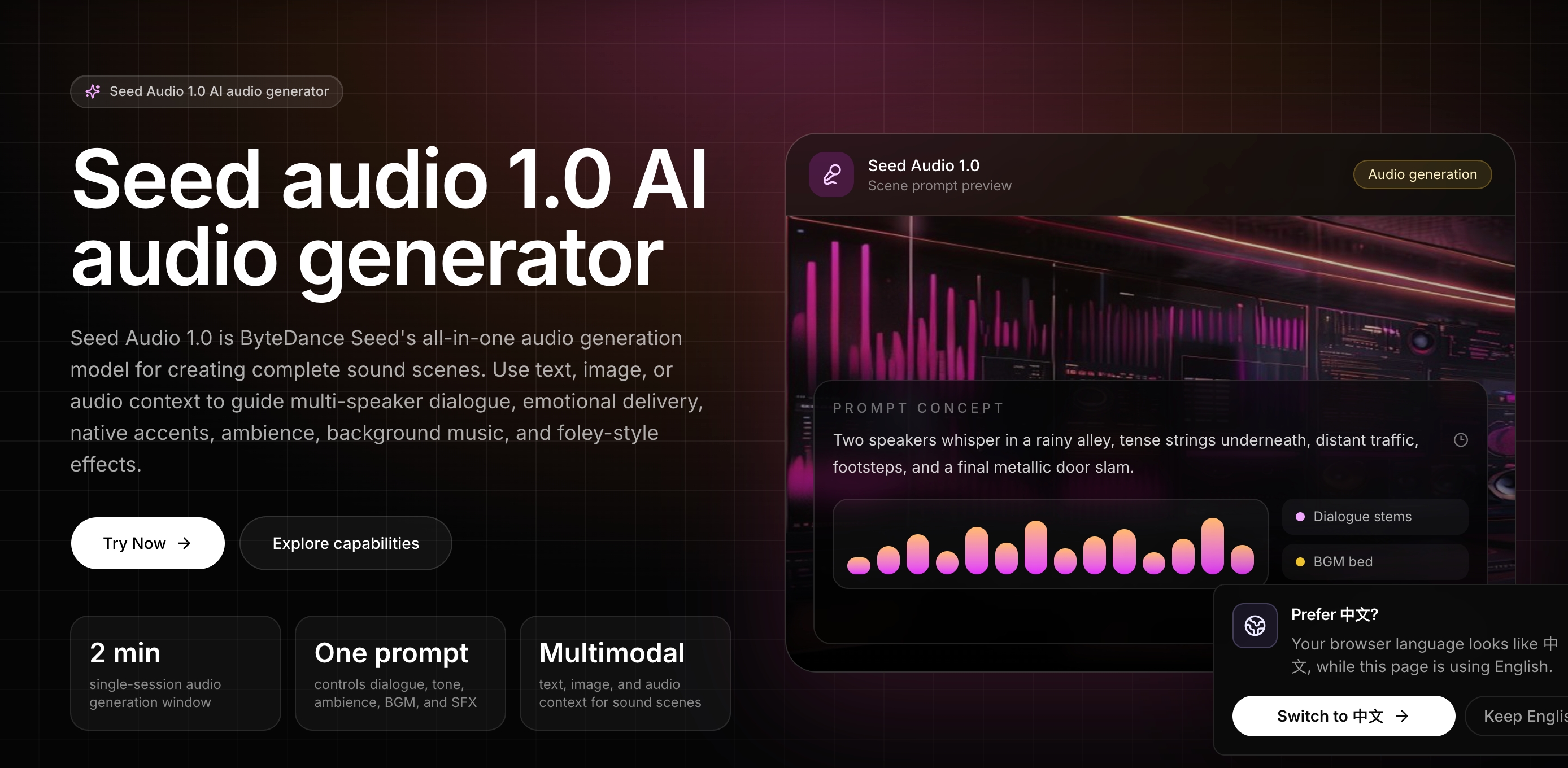




Seed Audio 1.0 is a multimodal AI audio generation model from ByteDance Seed designed to produce complete sound scenes from a single prompt. Rather than generating isolated speech or background tracks, it composes dialogue, emotional delivery, ambience, background music, and foley-style effects together in one pass. The tool targets creators who need layered audio for short films, advertisements, podcasts, games, and learning content without stitching separate tracks from different services.
What makes the public workspace worth examining is its approach to audio creation. You describe a scene with characters, emotion, timing, location, and sound events, and the model assembles multiple layers at once. The result is a single output containing dialogue stems, BGM beds, and environmental or effect layers. For teams that previously relied on multiple tools to build a coherent audio scene, this consolidates a significant part of the workflow into one prompt-driven interface.
The Seed Audio 1.0 homepage (https://seedaudio.co/) highlights several core capabilities that distinguish it from standard text-to-speech generators:
Seed Audio 1.0 fits scenarios where a project needs more than simple narration or isolated sound effects:
Seed Audio 1.0 operates on a credit-based system with both subscription plans and one-time credit packs. Every paid plan includes API access, with a single shared credit balance across the web app and API.
The Seed Audio 1.0 pricing page (https://seedaudio.co/pricing) also lists monthly billing options and one-time credit packs for flexible top-ups. The API charges 75 credits per generated minute with a 10-credit minimum, and reserves 150 credits before a task starts to prevent overspending.
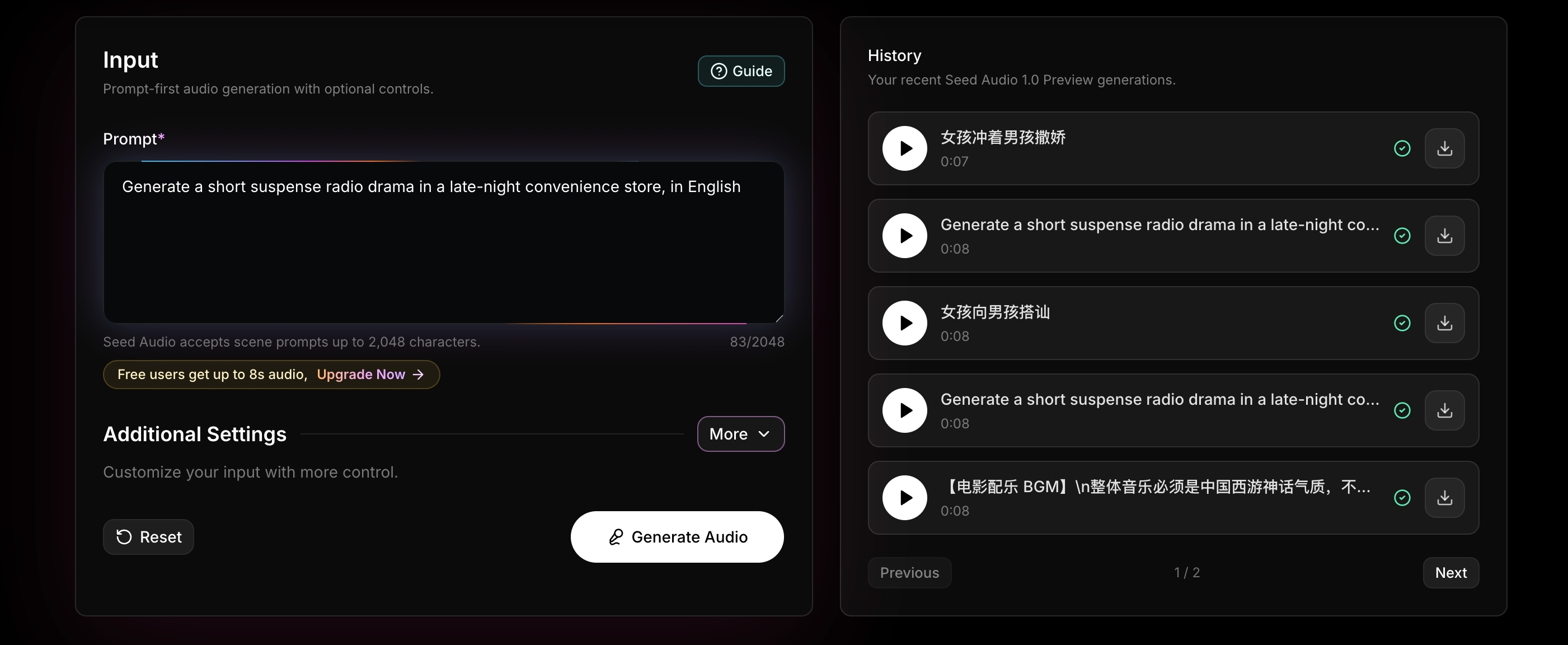
The browser workspace provides a straightforward flow: write a sound-scene prompt, optionally attach audio or image references, configure output settings, and generate. A built-in prompt guide and templates help new users structure effective scene descriptions, and an optimize-prompt feature can refine draft prompts before generation.
For support, the site references priority support for paid plan subscribers and a contact email for billing or custom needs. A prompt guide, API documentation, and an acceptable use policy are available on the site. The public page does not show a live chat, help center, or community forum, so users evaluating support options may want to verify response times and coverage before committing to a paid plan.
The Seed Audio 1.0 API documentation (https://seedaudio.co/openapi) reveals several integration-relevant details:
The web workspace runs in the browser and requires sign-in for generation history. The public page does not specify browser requirements, supported audio input formats for references, or minimum system requirements for the workspace.
Pros
Cons
The model produces dialogue with emotional delivery, background music, environmental ambience, and foley-style sound effects in one layered output. You describe the full scene, and the model composes multiple audio layers including dialogue stems, BGM beds, and combined ambience plus effects tracks.
Each generation supports a maximum of 2 minutes of audio. For longer projects, you would need to generate multiple segments and combine them in post-production.
The public page lists commercial usage as a frequently asked question. Users should verify the current terms of service and acceptable use policy on the site before using generated audio in commercial projects.
You can provide up to three audio references for voice or style direction, or one reference image to guide mood and scene context. Audio references and image references cannot be combined in the same request.
API tasks reserve 150 credits before starting, then settle against actual generated duration at 75 credits per minute. Unused credits from the reservation are returned automatically. Failed tasks refund the full reservation.
The tool appears most useful for content creators, sound designers, game developers, and marketing teams who need layered audio scenes quickly. Projects requiring multi-character dialogue with environmental sound and music are the natural strength. Teams with high-volume needs may benefit from the API batch workflow.
Failed tasks return the full credit reservation to your balance. The site also mentions internal provider fallback, so transient provider issues may be handled automatically before a task reaches a failed state.
Seed Audio 1.0 occupies a specific niche in AI audio generation: scene-level composition rather than isolated speech or music. For creators who need dialogue, ambience, music, and effects blended into a coherent output from a single prompt, the tool removes the friction of coordinating multiple services or recording sessions. The credit-based pricing with a free tier makes it accessible for evaluation, and the API provides a clear path for teams building automated audio pipelines.
Before committing to a paid plan, it is worth testing the free tier with your actual use cases to check voice quality, scene coherence, and whether the 2-minute generation limit fits your workflow. Review the pricing page (https://seedaudio.co/pricing) for current plan details and verify the terms of service for commercial usage rights relevant to your projects.
griffin Peter

The One Startup : Navigate. Build. Grow.

Build Trust with DR Checker

Discover the Best AI Tools & SaaS Solutions
Get your brand featured here
Discover similar products in the same category

## Introduction ShipBoost is a product launch and distribution platform built for bootstrapped SaaS founders. The site combines a weekly launch board - where new products compete for visibility during a set week - with permanent public listings, category and tag discovery pages, and a paid editorial article option that continues to attract search traffic after launch week ends. The site's framing is direct: most launch sites give you a traffic spike that fades, and most directories give you a static listing that nobody finds. ShipBoost attempts to do both jobs - launch visibility and ongoing discoverability - in one place. For founders who want a launch moment that also produces lasting search assets, the platform offers a two-layer approach. ## Key Features - **Weekly Launch Board** - products launch in a weekly cohort with ranked placement, upvotes, and gold/silver/bronze positioning rather than a daily reset that buries products overnight - **Permanent Public Listing** - every launched product gets a founder-ready listing page that stays indexed in categories and tags after the launch board rotates - **Premium Editorial Article** - paid option that produces a hand-written article about the product on the ShipBoost blog, providing a permanent search asset with a dofollow link - **Category and Tag Discovery** - products are organized by category (Marketing, Sales, Support, Productivity, Development, Design) and tagged by workflow, making them findable through browsing and search - **Alternatives Pages** - editor-curated comparison pages (e.g., HubSpot Alternatives, Zendesk Alternatives) that target higher-intent search traffic - **Sponsorship Placements** - product ads, banner ads, and sidebar ads for paid visibility across discovery pages - **Done-for-You Directory Submission** - partner service that manually submits products to 30-100+ AI and startup directories, with a report after delivery - **Free and Premium Launch Tiers** - free launch for a basic listing and one week on the board; premium launch adds the editorial article, date reservation, and featured placement ## Use Cases Bootstrapped SaaS founders preparing a product launch can use the weekly board for focused launch-week visibility, then rely on the permanent listing and category pages for ongoing discovery. The Premium Launch's editorial article gives founders a piece of content they can share, link to from their own site, and rank for in search - a lasting asset that daily-launch platforms do not provide. Founders who want distribution beyond a single site can use the done-for-you directory submission service (starting at $99 for 30+ directories) to get their product listed across multiple AI and startup directories without managing each submission individually. Teams looking for sustained paid visibility can sponsor placements on ShipBoost's category and discovery pages, where the audience is actively evaluating tools rather than browsing for entertainment. ## Pricing ShipBoost offers launch tiers and sponsorship placements: - **Free Launch** - $0 forever: one week on the launch board, permanent public listing, indexed in category and tag pages, website link (nofollow by default; add the badge to upgrade to dofollow) - **Premium Launch** - $9/launch (founding offer, originally $19; 3 of 20 founding spots remaining): hand-written editorial article on the ShipBoost blog, reserve a specific launch week, featured placement on the board, guaranteed dofollow link from listing and article - **Product Ad** - $29/30 days: native placement in the launchboard feed, limited to 2 slots for exclusivity - **Banner Ad** - $49/30 days: full-width animated banner mid-feed, exclusive (1 sponsor at a time) - **Sidebar Ad** - $59/30 days: product card across all discovery pages, highest impression rate - **Directory Submission** - Starter $99 (30+ directories), Pro $149 (60+ directories), Premium $199 (100+ directories); handled by partner AI Directories All sponsorships are one-time payments with no subscription or auto-renewal. The [pricing page](https://shipboost.io/pricing) has full details. ## User Experience and Support The submission flow requires an account, which ties the draft, listing, and launch status to a single founder workflow. Drafts can be saved and returned to later. The weekly board uses a clean card layout with gold, silver, and bronze rankings, making it easy to compare products at a glance. The site includes a FAQ section, a Launch Guide, a How It Works page, and a Startup Directories resource. A contact page is available for direct inquiries. The site is transparent about being early-stage - it acknowledges that it does not yet have "mature traffic proof" and emphasizes that the surfaces (blog, board, categories, alternatives) are live and functional regardless. ## Technical Details ShipBoost runs as a web application with a dark-mode interface. The platform organizes products into six main categories (Marketing, Sales, Support, Productivity, Development, Design) with sub-tags for workflow-specific discovery. The alternatives pages (HubSpot Alternatives, Zendesk Alternatives, etc.) are editor-curated for search-intent traffic. The directory submission service is handled by a partner (AI Directories) and is manual rather than automated. Products can display a verification badge and a "Featured on" attribution for use on their own sites. The platform supports English. ## Pros and Cons **Pros** - Combines launch-week visibility with permanent listing and long-tail discovery - Premium editorial article is a lasting search asset, not just a one-day boost - Weekly cohort model gives each product more sustained visibility than a daily reset - Transparent about early-stage status - no inflated traffic claims - Free tier provides genuine value without payment - Directory submission service saves founders time on manual submissions **Cons** - Audience size is still growing - the site is early-stage - Premium Launch founding spots are limited (3 of 20 remaining at the discounted price) - Category pages for some verticals have relatively few listed products - Directory submission service is outsourced to a partner, not handled in-house ## FAQ ### What is ShipBoost and who is it for? ShipBoost is a product launch and distribution platform for bootstrapped SaaS founders. It offers a weekly launch board for immediate visibility, permanent listings for ongoing discovery, and a paid editorial article option that keeps working in search after launch week. The platform is designed for founders who want a launch to produce lasting distribution assets rather than a one-day traffic spike. ### How is ShipBoost different from daily launch sites? Daily launch sites reset every 24 hours, which means products can get buried before the right buyers see them. ShipBoost uses a weekly cohort model that keeps products visible for a full week. After launch week, products keep appearing through permanent listings, category pages, tag pages, and - for Premium launches - editorial articles on the blog. ### What does the Premium Launch include? The Premium Launch ($9 during the founding offer) adds a hand-written editorial article about the product on the ShipBoost blog, the ability to reserve a specific launch week, featured placement on the board, and a guaranteed dofollow link from both the listing and the article. The article is a permanent asset that founders can share, link to, and rank for in search. ### Is there a free launch option? Yes. The Free Launch costs $0 and includes one week on the launch board, a permanent public listing, and indexing in category and tag pages. The website link is nofollow by default, but adding the ShipBoost badge to the product's site upgrades it to dofollow at no extra cost. ### What is the directory submission service? ShipBoost partners with AI Directories to offer manual submission to 30-100+ AI and startup directories. Pricing starts at $99 for 30+ directories. The service is handled manually (not automated or scraped) and includes a detailed report after delivery. ### How does ShipBoost handle alternatives pages? ShipBoost publishes editor-curated comparison pages (e.g., HubSpot Alternatives, Zendesk Alternatives) that are built for higher-intent search traffic. These pages help buyers compare tools and give listed products additional discovery paths beyond category browsing. ## Conclusion ShipBoost addresses a real gap between launch-day platforms and static directories by combining both in a single system: weekly launch-board visibility for the spike, permanent listings for the baseline, and editorial articles for the long tail. The transparent early-stage positioning and the free launch tier make it straightforward for founders to test the platform without risk. For bootstrapped SaaS teams that want a launch to produce assets that keep working after the board resets, the [ShipBoost site](https://shipboost.io) is worth a closer look.

All-in-one toolkit: calculator, converter, compass, flashlight, notes, random generator – offline, c