


Seed Audio 1.0 is ByteDance Seed's all-in-one audio generation model for creating complete sound sce


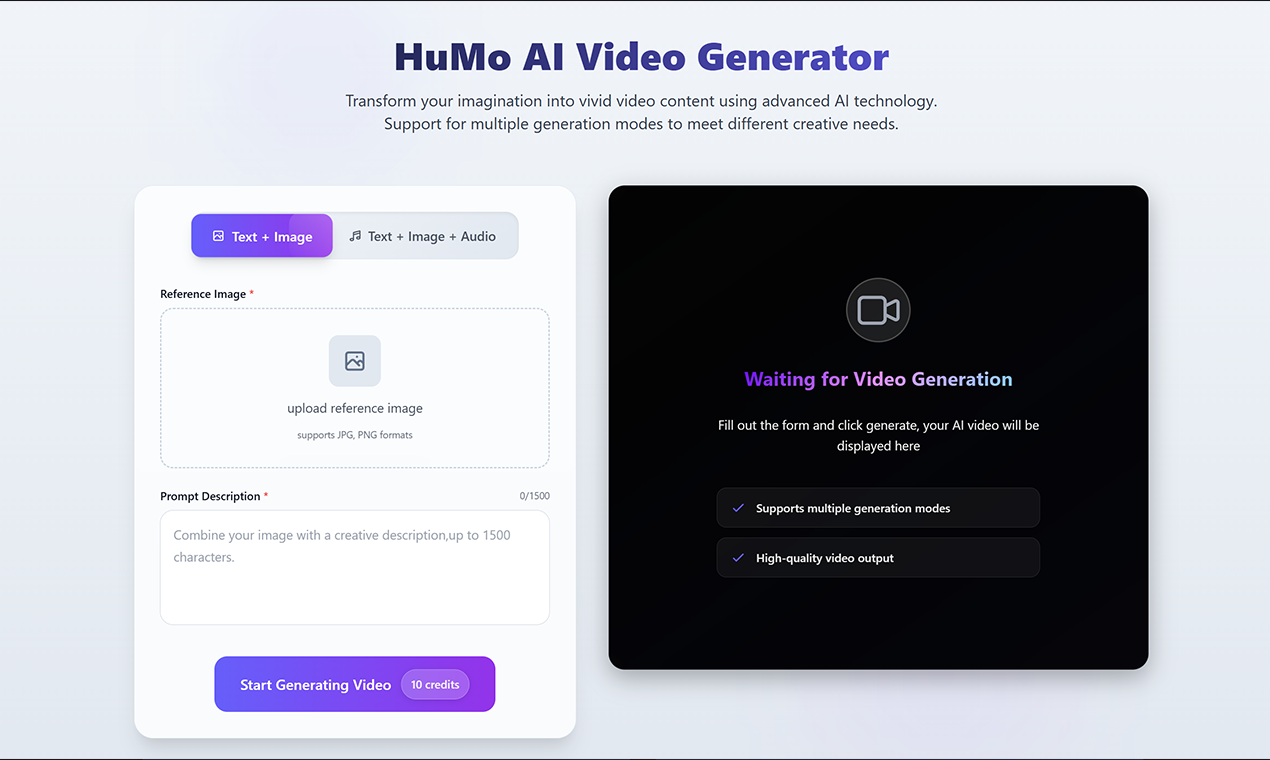
HuMo AI is a multi-modal video generation tool built on ByteDance's video generation technology, developed in collaboration with Tsinghua University. It creates human-centric videos from text, image, and audio inputs with a focus on subject consistency, audio-visual synchronization, and text-controllable editing. For content creators, marketers, and developers who need to produce human-focused video without filming, the platform offers a credit-based system with one-time purchase plans - no subscription required.
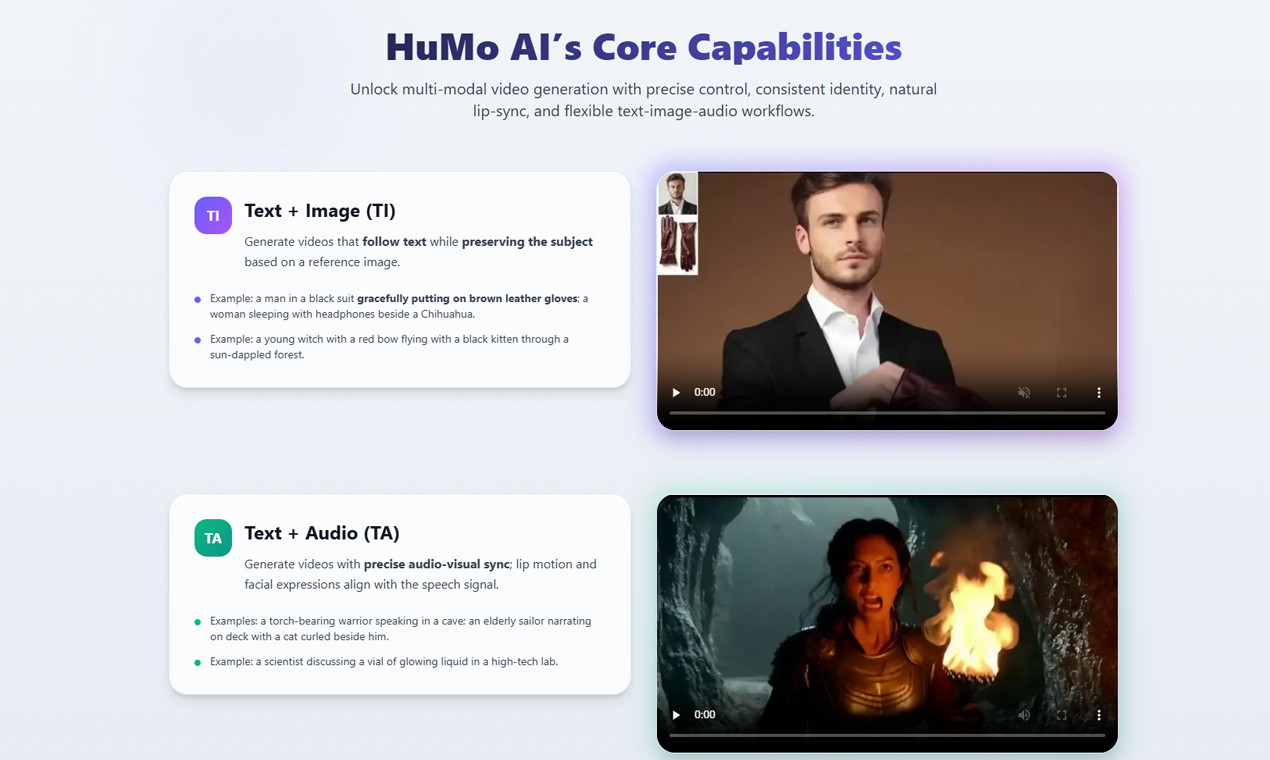
For digital human and virtual avatar creation, HuMo AI generates expressive characters from text, image, and audio inputs. The subject consistency and audio-driven motion make it suitable for virtual influencers, interactive characters, and branded digital presenters who need to appear across multiple videos with a consistent look.
For marketing and social media content, the text-to-video and image-to-video modes allow quick production of promotional clips without a production team. A brand can describe a scenario in text, provide a product image, and generate a short video for social channels with controlled style and fast turnaround.
For education and training content, the platform can produce explainer videos, lesson demonstrations, and language-learning material from text descriptions. The audio-driven mode supports dialogue-heavy educational content where a character needs to speak naturally.
For storytelling and creative prototyping, filmmakers and content creators can use the multi-modal pipeline to visualize narrative scenes from scripts, reference images, and voice recordings - useful for pitch materials, concept reels, and early-stage creative exploration.
HuMo AI uses a one-time purchase credit model with no subscription. Credits never expire on purchased plans. The Starter plan costs $9.90 and includes 100 credits ($0.083 per credit) with standard queue speed and a commercial use license. The Advanced plan is $29.90 (discounted from $33) with 420 credits ($0.071 per credit), HD video generation, and priority queue speed. The Pro plan at $59.90 includes 950 credits ($0.063 per credit) with HD generation and priority queue. The Premium plan costs $89.90 with 1,630 credits ($0.055 per credit), HD generation, priority queue, and priority support. All paid plans include a commercial use license and a 7-day money-back guarantee. Payment is processed through Stripe.
The platform is browser-based with no software installation required. The generation interface appears to follow a straightforward workflow: select a mode, provide inputs, configure resolution, and generate. Support is available via email at support@humoai.co, with priority support included on the Premium plan. The site includes a pricing FAQ, capability showcase pages, and customer testimonials. A Seedance 2.0 mobile app is referenced in the navigation, suggesting mobile access may be available or planned.
HuMo AI is built on ByteDance's video generation technology and developed in collaboration with Tsinghua University and the ByteDance Intelligent Creation Team. The platform supports five generation modes: Text + Image (TI), Text + Audio (TA), Text + Image + Audio (TIA), Text Control/Edit, and subject preservation with A/V sync comparisons. Video generation deducts credits based on resolution and duration, with the exact cost displayed on the Generate button before confirmation. The site uses Stripe for payment processing and does not store card details.
Pros
Cons
HuMo AI is a multi-modal video generation platform that creates human-centric videos from text, image, and audio inputs. It differentiates itself through subject consistency (preserving a person's identity across clips) and audio-visual synchronization (aligning lip motion and facial expressions with speech). The platform is built on ByteDance's video generation technology in collaboration with Tsinghua University.
Credits are the currency for video generation on HuMo AI. Each generation deducts credits based on resolution and duration - for example, a 5-second clip uses approximately 17 credits at 480p, 38 at 720p, and 93 at 1080p. The exact cost is shown before you confirm generation. Credits on one-time plans never expire.
Yes. All paid plans include a commercial use license. You can use generated videos in client work, advertisements, social media, and other commercial projects.
HuMo AI supports five generation modes: Text + Image, Text + Audio, Text + Image + Audio, Text Control/Edit (changing appearance while preserving identity), and subject preservation with A/V sync. Each mode serves different creative needs, from concept visualization to lip-synced dialogue.
Yes. All paid plans come with a 7-day money-back guarantee. Email support@humoai.co for a full refund.
Videos can be generated at 480p, 720p, or 1080p. Credit consumption scales with resolution - 1080p uses roughly 5.5x more credits than 480p for the same duration. The exact cost is displayed on the Generate button before confirmation.
HuMo AI occupies a specific niche in the AI video generation space: human-focused videos with subject consistency and audio-visual sync, powered by ByteDance's technology. The one-time credit model with no expiration is a practical alternative to subscription-based competitors, and the multi-modal input system covers a reasonable range of creative workflows. For creators, marketers, and developers who need to produce human-centric video content without filming, the platform is worth evaluating - though readers should verify the third-party tool site's relationship with ByteDance and Tsinghua University, and test the credit costs at their intended resolution before committing to a larger plan.
Felice Bodziony

Build Trust with DR Checker
Discover the Best AI Tools & SaaS Solutions
The One Startup : Navigate. Build. Grow.

Get your brand featured here
Discover similar products in the same category

Seed Audio 1.0 is ByteDance Seed's all-in-one audio generation model for creating complete sound sce

## Introduction Honeyb is AI visibility software built for Answer Engine Optimization - the practice of monitoring and improving how brands appear in AI-generated answers. The platform tracks brand mentions, recommendation share, sentiment, and citation sources across eight AI engines (ChatGPT, Gemini, Claude, Perplexity, Google AI Mode, Google AI Overviews, Microsoft Copilot, and Grok) and delivers daily visibility scores with weekly recommendations. The core insight on the site is direct: when a buyer asks an AI for the best tool or vendor, the answer is a shortlist of three to five names, and there is no second page to climb. Honeyb gives marketing teams a way to see which shortlist they are on - and which ones they are not. ## Key Features - **AI Visibility Score** - a daily percentage showing how often the brand appears in AI answers, tracked against competitors over 7-day, 30-day, and 90-day windows - **Topic Performance** - visibility broken down by topic category (e.g., project management, team collaboration), showing where the brand appears and where it does not - **Citation Source Tracking** - domain-level breakdown of which sources (G2, Forbes, Reddit, Product Hunt, etc.) the AI models cite when mentioning the brand - **Sentiment and Risk Monitoring** - tracks whether AI mentions are positive, neutral, or negative, and flags emerging risks - **Competitor Benchmarking** - compare visibility and recommendation share against named competitors in each workspace - **Honeyb Recommendations** - weekly actionable suggestions on content, sources, and PR moves, ranked by estimated impact - **Workspace Organization** - group tracking by brand, product line, audience, market, or language, with separate competitors and citations per workspace - **Free AI Visibility Check** - enter a domain and get an instant visibility report across AI platforms without signing up ## Use Cases SEO and content teams can use Honeyb to understand which topics and source citations drive AI recommendations in their category, then adjust their content and PR strategy to improve visibility. The citation source breakdown shows whether review sites, editorial coverage, or forum mentions are doing the most work - which directly informs where to invest outreach effort. PR and brand teams tracking reputation across AI engines can monitor sentiment and risk signals daily, catching negative mentions or competitive displacement early. Because AI answers are concise and influential - the site notes that AI typically returns three to five names - a brand that disappears from the shortlist effectively ceases to exist for that buyer query. Global brands operating across multiple markets and languages can use workspaces to track visibility per region or product line, with separate competitor sets and citation tracking for each. The Full Spectrum and Enterprise tiers support multi-brand, multi-market, and multi-language monitoring in a single account. ## Pricing Honeyb offers four tiers with monthly or annual billing (20% discount on annual): - **The Minimum** - $29/month: 10 prompts daily, 1 AI engine of choice, 1 workspace, 1 seat, competitor tracking, citation tracking, Honeyb Recommendations, weekly email report, email support (no free trial) - **Multi-Model** - $79/month: 50 prompts daily, 3 engines of choice, up to 5 workspaces, unlimited seats, multi-brand/multi-market/multi-language tracking, 14-day free trial - **Full Spectrum** - $149/month: 100 prompts daily, all 8 engines (including Google AI Mode and AI Overviews), up to 10 workspaces, unlimited seats, monthly 30-minute visibility review with the Honeyb team, priority support, 14-day free trial - **Enterprise** - custom pricing: custom prompt volume (fair-use), all 8 engines plus new models on launch, unlimited workspaces and seats, custom prompt strategies built with the Honeyb team, white-label reporting, API access, SSO/SAML, audit logs, quarterly business review, dedicated account manager, dedicated Slack channel, priority onboarding The [pricing page](https://www.honeyb.ai/pricing) has full details and a plan-comparison table. ## User Experience and Support The dashboard centers on an AI Health Report with four panels: visibility score and trend, topic performance, top citation sources, and sentiment and risks. Users set up tracking in five steps: add prompts (the questions buyers ask), add competitors, choose AI models to track, view the daily visibility score, and act on weekly recommendations. Support varies by tier: email support on The Minimum and Multi-Model, priority support with monthly 30-minute reviews on Full Spectrum, and a dedicated Slack channel with account manager on Enterprise. All paid tiers above The Minimum include a 14-day free trial. The company is registered in Latvia (SIA Honeyb, Reg. Nr. 40203724531). ## Technical Details Honeyb runs as a web platform. It tracks eight AI engines: ChatGPT, Google AI Mode, Google AI Overviews, Microsoft Copilot, Perplexity, Gemini, Grok, and Claude. Workspaces organize tracking by brand, product line, audience, market, or language, with a minimum of 10 prompts per workspace. The Enterprise tier adds API access, SSO/SAML authentication, audit logs, and white-label reporting. The site mentions Slack integration for the Enterprise tier's dedicated channel. No browser extension or CMS plugin is listed. ## Pros and Cons **Pros** - Addresses a real gap: most marketing teams cannot see what AI models tell buyers about their brand - Tracks eight AI engines including Google AI Mode and AI Overviews, which are emerging search surfaces - Citation source breakdown shows exactly which external content drives AI recommendations - Workspace model supports multi-brand, multi-market, and multi-language tracking - Free visibility check requires no sign-up, lowering the barrier to first insight - Weekly recommendations turn monitoring data into actionable next steps **Cons** - The Minimum tier has no free trial, which may discourage testing at the entry level - Prompt-based tracking means users must define the questions to monitor; coverage depends on prompt quality - Pricing starts at $29/month for a single engine, which may feel steep for small brands testing one model - Enterprise pricing is not publicly listed ## FAQ ### What is Honeyb and what problem does it solve? Honeyb is AI visibility software for Answer Engine Optimization. It tracks how brands appear in AI-generated answers across ChatGPT, Gemini, Claude, Perplexity, and other AI engines. The problem it addresses: when buyers ask AI for recommendations, the answer is a shortlist of three to five names, and brands that do not appear effectively do not exist for that query. ### How does Honeyb differ from traditional SEO tools? Traditional SEO tools track rankings in search engine result pages with ten blue links. Honeyb tracks visibility in AI-generated answers, which return a small set of names rather than a ranked list. The site FAQ addresses this comparison directly. ### What is a workspace in Honeyb? A workspace is a grouping for tracking - one per brand, product line, audience, market, or language. Each workspace has its own competitors, citations, and recommendations. The minimum is 10 prompts per workspace. ### Does Honeyb offer a free trial? The Minimum tier does not include a free trial. Multi-Model, Full Spectrum, and Enterprise all include a 14-day free trial. There is also a free AI visibility check that does not require sign-up. ### What AI engines does Honeyb track? Honeyb tracks eight engines: ChatGPT, Google AI Mode, Google AI Overviews, Microsoft Copilot, Perplexity, Gemini, Grok, and Claude. The Minimum tier covers one engine, Multi-Model covers three, and Full Spectrum and Enterprise cover all eight. ### Can I switch tiers later? Yes. The site FAQ confirms that users can switch between tiers as their monitoring needs change. ## Conclusion Honeyb targets a problem that most marketing teams have not yet instrumented: understanding what AI models tell buyers about their brand. The daily visibility score, citation source breakdown, and weekly recommendations turn an invisible channel into a measurable one. The free visibility check is a practical entry point, and the workspace model scales from a single-engine monitor to multi-brand, multi-market tracking. For teams that want to see - and improve - their position in AI-generated answers, the [Honeyb site](https://www.honeyb.ai/) is the place to start.