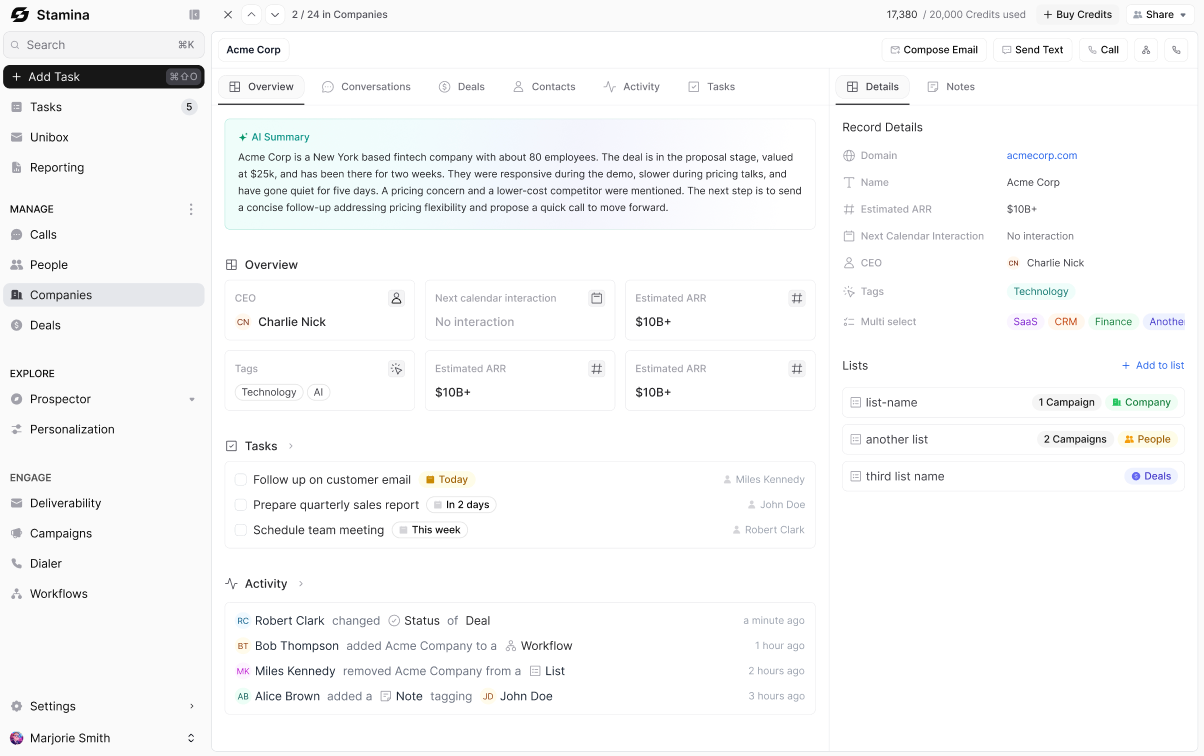
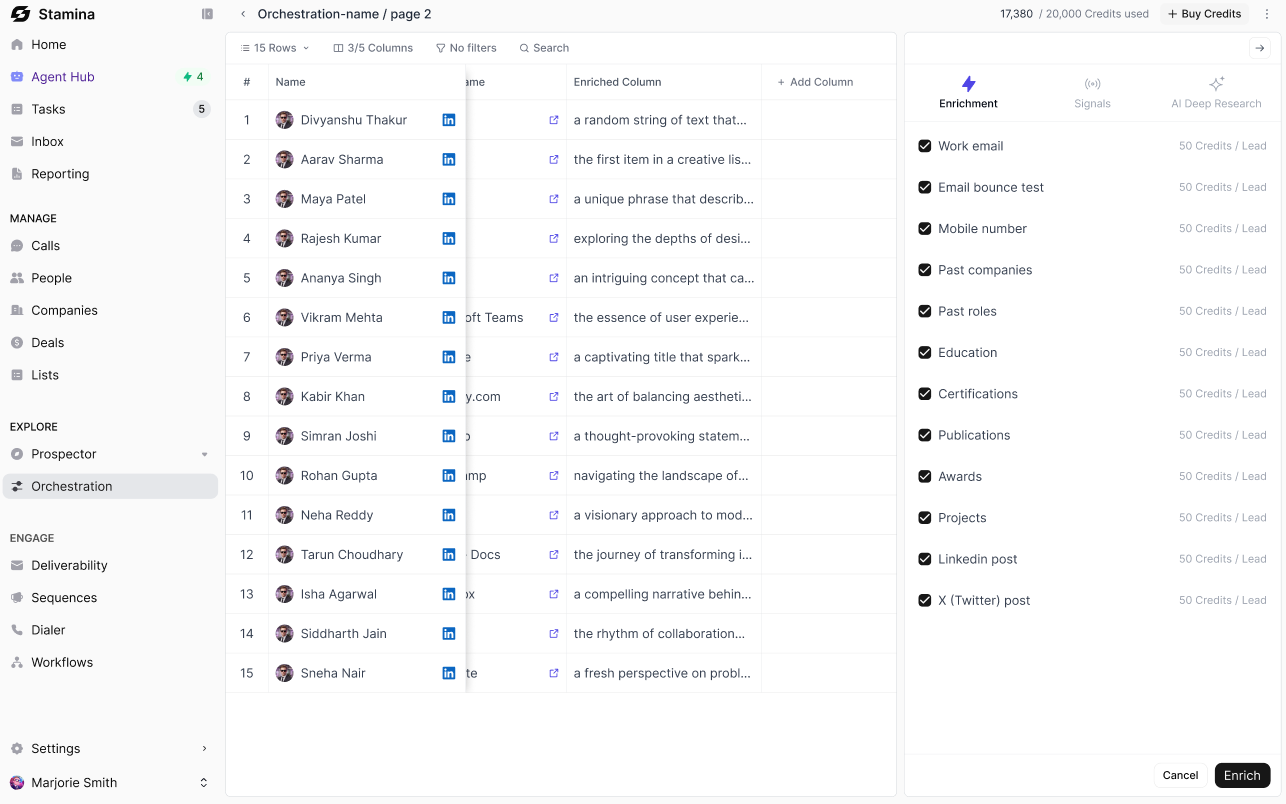
Stamina presents itself as an all-in-one outbound sales platform targeting small and medium-sized businesses. The product combines CRM functionality, email outreach, SMS campaigns, power dialer capabilities, and AI-driven prospecting into a single integrated system. The positioning emphasizes eliminating the need for multiple disconnected tools-the "patchwork stack" problem common in B2B sales operations.
The platform's value proposition centers on providing both technology and human expertise. Every client receives a dedicated "GTM engineer" who functions as an extension of their sales team, handling strategy, campaign configuration, and ongoing optimization. This hybrid approach suggests Stamina recognizes that software alone rarely solves complex sales challenges.
What a careful reader should verify: whether the integrated toolset matches the depth of standalone solutions, how the dedicated support model scales, and whether the AI prospecting delivers actionable leads or requires significant manual filtering.
Stamina structures its platform around several core capabilities. The CRM component provides contact management and pipeline tracking. Email functionality supports sequencing and personalization at scale. SMS campaigns extend reach through mobile channels. The power dialer enables high-volume calling with workflow automation.
The AI prospecting feature leverages a database of 500 million verified contacts. The system emphasizes precision over volume, suggesting intelligent filtering rather than bulk list generation. This positions the platform for targeted account-based approaches rather than spray-and-pray tactics.
The dedicated GTM engineer service differentiates Stamina from pure SaaS competitors. These specialists handle ICP definition, list building, messaging frameworks, and ongoing optimization based on reply rate analysis and performance data. The model implies hands-on support for campaign iteration and list refinement.
Integration capabilities remain unspecified in the fetched content. Prospective users should verify compatibility with existing sales infrastructure and data migration paths.
Stamina targets B2B sales teams running high-volume outbound operations. The platform suits organizations seeking to consolidate multiple point solutions into a unified workflow. Companies without dedicated sales operations staff may particularly benefit from the included GTM engineer support.
The 500 million contact database suggests use cases spanning market expansion, account-based selling, and pipeline generation for growth-stage companies. The precision-over-volume messaging indicates suitability for teams with defined target markets rather than broad consumer outreach.
Agencies and consulting firms managing outbound for multiple clients represent another potential use case, assuming the platform supports multi-account structures and client-specific workflows.
Pricing details are not visible in the fetched website content. The platform advertises "simple, transparent pricing" but specific tiers, per-seat costs, and feature differentiation remain unspecified. Prospective users should visit the pricing page for current rates.
Given the dedicated GTM engineer component, pricing likely reflects both software access and services bundled together. This hybrid model may not suit teams seeking pure self-service tooling or those with limited budgets for managed services.
The support model defines the Stamina experience. Every client receives a dedicated GTM engineer-not chatbot, not help documentation, but a human specialist embedded in their outbound operations. This resource architects strategy, configures campaigns, optimizes sequences, and ensures pipeline generation rather than mere activity metrics.
The platform claims 1,000+ customers across 50+ countries, suggesting sufficient scale to refine their service model. The onboarding likely involves substantial collaboration with the assigned engineer for ICP definition, messaging framework development, and initial campaign setup.
Self-service capabilities within the platform itself are unclear from the available evidence. Organizations preferring hands-on control over every campaign parameter should verify the balance between guided support and direct access.
Stamina operates as a cloud-based SaaS platform, requiring no on-premises installation. The technical architecture combines data infrastructure for the 500 million contact database with workflow automation for multi-channel sequencing.
The AI prospecting component likely employs machine learning models for contact scoring, intent detection, and message personalization. Technical documentation regarding data sources, update frequency, and compliance frameworks would require direct inquiry.
Security considerations including data handling practices, SOC compliance, and GDPR alignment are not detailed in the fetched content. Enterprise buyers should request appropriate documentation before implementation.
Pros:
Cons:
Stamina assigns each client a dedicated engineer who functions as an extension of their team. This specialist handles strategic elements including ideal customer profile definition, list building, messaging frameworks, and ongoing optimization. The model emphasizes collaboration over ticket-based support, with the engineer proactively analyzing reply rates and refining campaigns.
The platform integrates email, SMS, and voice calling through its power dialer. This multi-channel approach enables sophisticated sequencing across touchpoints. The specific capabilities for each channel-deliverability monitoring, compliance features, call recording-should be verified directly with the vendor.
Stamina emphasizes "precision over volume" in its prospecting claims. The verification methodology, update frequency, and coverage by industry or geography are not detailed in public content. Prospective users should request sample lists and accuracy metrics relevant to their target market.
Integration capabilities are mentioned but not specified in the fetched content. Organizations using Salesforce, HubSpot, or other established CRMs should verify native connectors, data sync capabilities, and bidirectional update workflows before committing.
The platform serves "every size business" according to its positioning. However, the dedicated engineer model may create minimum viable pricing thresholds. Smaller teams should clarify whether the services component is optional or mandatory, and whether self-service tiers exist for budget-conscious buyers.
Stamina occupies a specific niche in the crowded sales technology landscape: the hybrid platform combining integrated tooling with dedicated human expertise. For B2B sales teams overwhelmed by managing multiple point solutions or lacking internal operations resources, this model offers clear appeal.
The platform's success depends on execution of both components-software that genuinely replaces standalone tools without capability compromise, and engineers who deliver strategic value rather than basic configuration assistance. The 1,000+ customer base suggests many organizations find this balance acceptable.
Prospective buyers should approach Stamina as a services-augmented software purchase rather than a pure tool acquisition. The dedicated engineer relationship will likely determine success more than feature checklists. Teams comfortable with hands-on management of their own campaigns may find the model constraining; those seeking guided execution may find it exactly matches their needs.

Staminaio
The One Startup : Navigate. Build. Grow.

Discover the Best AI Tools & SaaS Solutions

Build Trust with DR Checker
Get your brand featured here
Discover similar products in the same category

Resize, compress, and export images without uploading them to a server