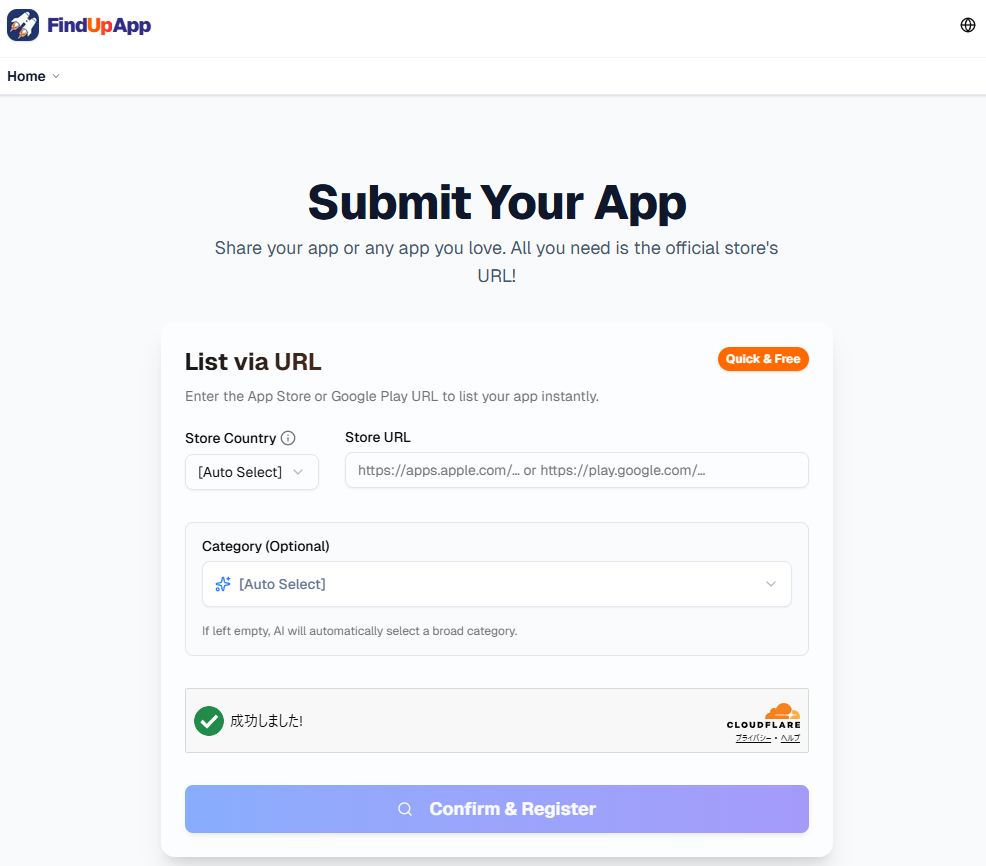
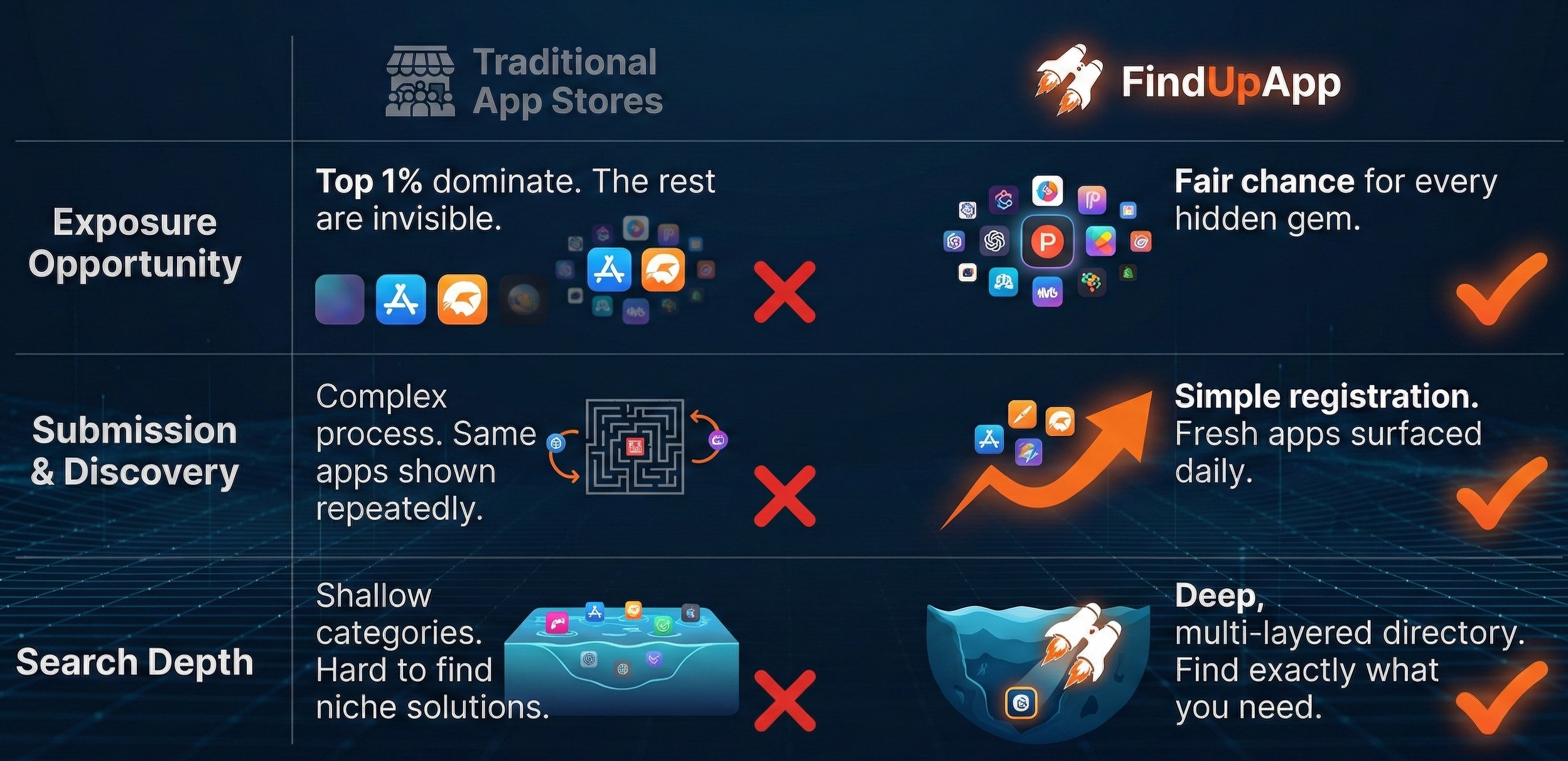


FindUpApp is an app discovery and listing platform for Android and iOS apps. The public page presents it as a free place to discover mobile apps and submit an app by entering an App Store or Google Play URL, which makes it most relevant for app makers seeking lightweight visibility and users who browse new mobile tools by category.
The clearest value is its straightforward catalog experience: visitors can browse categories, see recently registered apps, and scan short descriptions before deciding what to explore. A careful evaluator should still verify submission rules, listing review details, and any long-term promotion options, because the homepage focuses more on discovery and free listing than on detailed publisher workflow.
FindUpApp appears useful for mobile app builders who want a simple public listing without building a full promotional campaign around it. The site's promise to accept App Store or Google Play URLs suggests a low-friction path for adding an app, although makers should confirm whether all submissions appear automatically and whether any moderation, ranking, or update process applies.
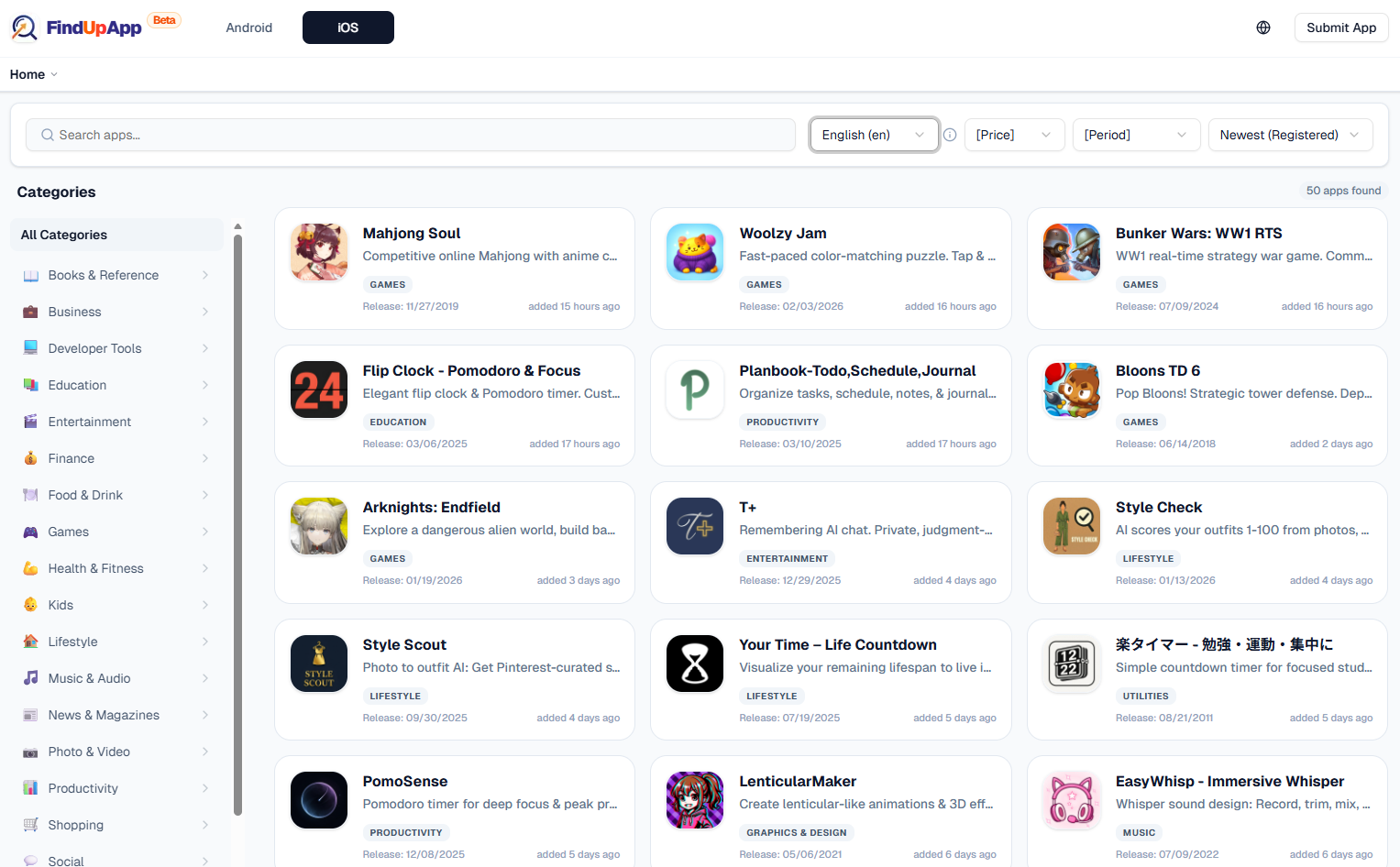
For app users, the platform works as a browsing surface for finding lesser-known Android and iOS apps. The visible category list is broad enough to support casual discovery across games, productivity, finance, health, education, travel, developer tools, and AI-related apps. The short descriptions make it easy to understand what an app claims to do before leaving the page to investigate further.
It may also help reviewers, newsletter writers, and product researchers spot newly registered mobile apps in a structured format. Because the homepage shows release dates, categories, and recently added entries, readers can quickly identify current app launches or niche tools worth deeper review. The trade-off is that the public evidence does not show advanced filters, traffic metrics, paid placement options, or detailed app performance data.
The homepage states that FindUpApp is a free platform to discover and submit apps for Android and iOS, and the meta description says users can "find and submit mobile apps for free." No paid plan, premium promotion package, subscription tier, or advertising price is visible in the fetched homepage evidence. App makers should verify whether free listing covers all available exposure or whether any paid visibility options exist outside the homepage.
FindUpApp's public interface appears built around direct browsing. The visible navigation includes Home, Android, iOS, Newest, and Categories, followed by a large category menu and a feed of app cards. Each listing includes an app name, a short description, category labels, a release date, and an added timestamp, which gives readers enough context to decide whether an app is worth opening or researching further.
Support signals are present but limited on the homepage. The footer lists Terms of Service, Privacy Policy, Frequently Asked Questions, and Contact & Bug Report, which suggests that users have routes for policy review, basic help, and issue reporting. The fetched evidence does not show the content of those support pages, so app submitters should check the FAQ and contact route before relying on the platform for time-sensitive launch visibility.
FindUpApp is presented as a web-based app discovery and listing platform rather than a native mobile app or developer SDK. The site explicitly references App Store and Google Play URLs for submission, and the visible navigation separates Android and iOS, which are the key platform signals available from the public page.
The homepage does not show an API, developer documentation, analytics dashboard, integration settings, or a technical stack. For most readers, the important technical question is likely whether a valid store URL is enough to create or update a listing. Publishers who need bulk submissions, listing edits, analytics, or automated updates should verify those capabilities directly with the site before planning around it.
Pros
Cons
FindUpApp is used to discover and list Android and iOS mobile apps. The public page describes it as an app discovery and listing platform where users can find apps and submit mobile apps for free.
It is most relevant for mobile app makers who want a simple public listing and for users who like browsing newly added apps by category. It may also be useful for product researchers who track recent mobile app launches.
The meta description says users can enter an App Store or Google Play URL to list an app. The homepage does not show the full submission workflow in the fetched evidence, so publishers should verify whether listings are instant, moderated, editable, or subject to additional rules.
The visible categories cover a wide range of mobile app types, including games, productivity, utilities, lifestyle, health and fitness, education, finance, business, travel, AI and technology, and developer tools. The homepage also shows example listings for expense tracking, plant care, puzzle games, bilingual stories, watch faces, and other app categories.
The public page says FindUpApp is free for discovering and submitting Android and iOS apps. No paid tiers or premium placement details are visible on the fetched homepage, so users who need promotional guarantees or special exposure should confirm whether any paid options exist.
The footer shows links for Frequently Asked Questions and Contact & Bug Report, along with Terms of Service and Privacy Policy. The available evidence does not include the content of those pages, so users should review them directly for submission support, policy details, and issue reporting expectations.
The homepage evidence does not show analytics dashboards, traffic metrics, conversion tracking, or ranking methodology. App makers should treat FindUpApp primarily as a public discovery and listing surface unless the site separately provides more detailed performance tools.
FindUpApp offers a straightforward way to browse and submit Android and iOS apps, with visible category navigation and a feed of recently added listings. Its strongest fit is for app discovery and lightweight listing visibility, especially when a maker wants a simple public page for a mobile app.
Before relying on it as a launch channel, users should review the FAQ, contact options, and any submission policies to understand how listings are created, updated, moderated, and displayed over time.
Discover the Best AI Tools & SaaS Solutions
The One Startup : Navigate. Build. Grow.

Build Trust with DR Checker
Get your brand featured here
Discover similar products in the same category

Invisible desktop teleprompter for screen sharing, recordings, Zoom calls, and live demos.

## Introduction BizHire is an AI-powered recruitment platform built by BizWorkHQ that automates the hiring process from job description creation through candidate screening, scoring, and interview scheduling. The platform targets startups, small businesses, remote companies, and staffing agencies that want to reduce the manual overhead of reviewing resumes, coordinating interviews, and tracking applicants. BizHire is part of the broader BizWork suite, which also covers IT service management, CRM, HRMS, and accounts - but BizHire focuses specifically on the recruitment pipeline. The site emphasizes speed and bias reduction, claiming the AI can cut repetitive hiring tasks and help teams make data-backed decisions faster. ## Key Features - **AI Job Description Generation** - creates role-specific, bias-free job descriptions in seconds, optimized for search visibility and candidate appeal - **AI Resume Parsing** - uploads and extracts skills, experience, and education from multiple resumes instantly, eliminating manual data entry - **AI Candidate Scoring** - ranks applicants based on job fit and defined criteria, using AI to evaluate skills, experience, and cultural fit - **Smart Screening** - automatically matches candidate profiles to role requirements, reducing hours of manual resume review - **AI Interviewer** - conducts initial interviews via AI chat or video for structured, consistent candidate screening - **Candidate Relationship Management** - tracks applicant history, notes, and activity to maintain engagement and build a talent pipeline - **Custom Scorecards** - allows teams to define their own evaluation formats (stars, numeric, etc.) for different roles and agencies - **Candidate Talent Pool** - reuses pre-screened candidates from previous hiring cycles so teams do not start from scratch for each new role - **Multi-Platform Job Posting** - posts jobs across multiple platforms with one click, including LinkedIn, Facebook, Twitter, Indeed, Glassdoor, and ZipRecruiter - **Reporting & Analytics** - provides hiring dashboards, time-to-hire and cost-per-hire reports, recruiter performance metrics, and source/channel performance scoring ## Use Cases Startups with limited hiring bandwidth can use BizHire to automate resume screening and candidate shortlisting, freeing the founding team to focus on growth rather than paperwork. The AI-generated job descriptions and smart screening reduce the time spent on repetitive early-stage tasks. Small businesses that receive high volumes of applications but lack a dedicated HR team can rely on the AI scoring and automated interview scheduling to move candidates through the pipeline without manual coordination. The platform's custom scorecards help maintain consistency across different roles. Staffing agencies managing multiple clients and open positions simultaneously can use the candidate talent pool and multi-platform job posting features to source and screen candidates at scale. The ability to reuse pre-screened candidates across roles is particularly relevant for agencies that fill similar positions repeatedly. Remote companies hiring across time zones benefit from the AI interviewer and automated scheduling, which handle initial screening without requiring synchronous availability from recruiters and candidates. ## Pricing BizHire offers a 7-day free trial for new users. The site mentions flexible plans based on hiring needs, suitable for startups through enterprises, but does not list specific prices on the public pages. Users are directed to contact the team at notifications@bizworkhq.com for a custom quote or to visit the pricing page for details. The lack of public pricing means teams will need to engage with sales to evaluate cost fit. ## User Experience and Support The platform follows a structured hiring workflow: AI generates job descriptions, resumes are parsed and scored, candidates are screened automatically, and interviews are scheduled with calendar integration. BizHire integrates with Google Meet, Zoom, Slack, Google Calendar, and Outlook, which covers most common communication and scheduling tools. The site features a "Request a Demo" option, a blog with posts on hiring topics, and case studies. Support contacts include an email address (notifications@bizworkhq.com). The platform also offers role-based access control so different team members can collaborate securely within the hiring workflow. ## Technical Details BizHire runs as a cloud-based platform and integrates with popular ATS systems, HR tools, and CRM platforms. The specific AI architecture is not disclosed, but the platform uses AI for resume parsing, candidate scoring, interview automation, and feedback analysis. Job distribution spans LinkedIn, Facebook, Twitter, Indeed, Glassdoor, and ZipRecruiter. The broader BizWork suite includes ITSM, CRM, HRMS, and accounts modules, suggesting BizHire can operate as part of a larger workforce management system. The site mentions GDPR and EEOC compliance, though the specifics of their compliance certifications are not detailed on the public pages. ## Pros and Cons **Pros** - Covers the full recruitment pipeline from job description to onboarding in one platform - AI-driven screening and scoring can significantly reduce manual review time - Multi-platform job posting with one click broadens candidate reach - Integrations with Zoom, Slack, Google Calendar, and Outlook fit common team workflows - Candidate talent pool feature helps avoid restarting the hiring cycle for similar roles - Part of a broader office management suite for teams that need HR, ITSM, and CRM together **Cons** - No public pricing, so evaluating cost requires a sales conversation - Specific AI architecture and model details are not disclosed - Compliance claims (GDPR, EEOC) are mentioned but not substantiated with audit details - The breadth of features across the BizWork suite may be more than teams looking only for recruitment need - The site's "50% cost savings" and "40% task reduction" claims are not independently verified ## FAQ ### What is BizHire and what does it do? BizHire is an AI-powered recruitment platform by BizWorkHQ that automates the hiring process - from generating job descriptions and parsing resumes to scoring candidates and scheduling interviews. It is designed for startups, small businesses, remote companies, and staffing agencies. ### Can BizHire integrate with my existing ATS? The site states that BizHire integrates with most ATS and HR systems. Specific integrations mentioned include Google Meet, Zoom, Slack, Google Calendar, and Outlook. Teams with less common ATS setups should verify compatibility before committing. ### Is BizHire suitable for small businesses? Yes. The platform is built to scale and specifically addresses small business use cases on its site, including automated screening and shortlisting for teams with limited HR capacity. ### How does the AI candidate scoring work? BizHire's AI scores candidates based on qualifications, skills, and cultural fit according to criteria defined for each role. Custom scorecards allow teams to adjust the evaluation format. The site does not disclose the underlying AI model or scoring methodology. ### What does BizHire cost? BizHire offers a 7-day free trial. Beyond that, pricing is not publicly listed. The site encourages users to contact the team at notifications@bizworkhq.com for a custom quote based on their hiring needs. ### Does BizHire handle interview scheduling? Yes. The platform automates interview bookings and syncs with calendars (Google Calendar, Outlook) to eliminate back-and-forth scheduling. It also offers an AI Interviewer feature that conducts initial screening interviews via chat or video. ### Is BizHire's hiring process compliant with fair hiring laws? The site mentions compliance with GDPR and EEOC and states that the AI is designed to reduce bias in screening and scoring. Organizations with specific compliance requirements should request documentation from the BizHire team to verify the details. ## Conclusion BizHire offers a feature-rich AI recruitment platform that covers the full hiring lifecycle from job posting to onboarding, with particularly strong automation around resume parsing, candidate scoring, and interview scheduling. The integrations with common tools like Zoom, Slack, and major job boards make it practical for teams already using those platforms. The main considerations are the absence of public pricing, the undisclosed AI methodology, and compliance claims that would need verification for regulated industries. For startups and small businesses looking to automate repetitive hiring tasks, BizHire's [7-day free trial](https://www.bizworkhq.com/ai-recruitment-software) is a reasonable starting point.